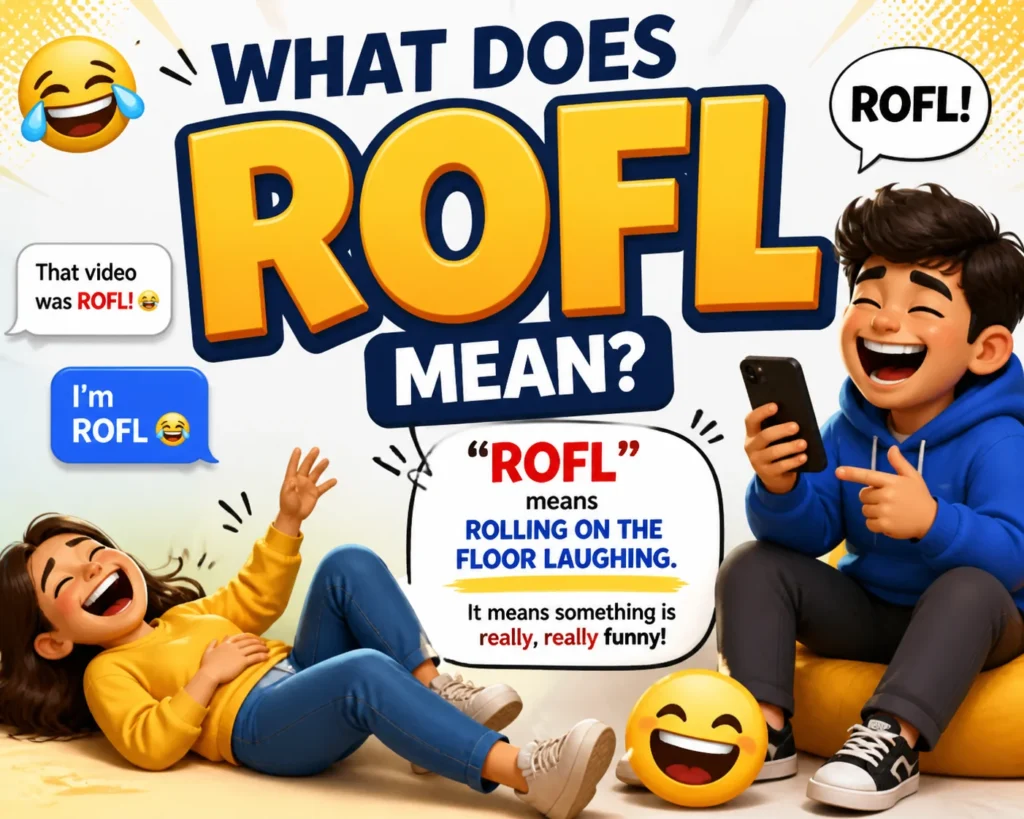
ROFL means “rolling on the floor laughing.” It is internet slang people use when something feels extremely funny, funnier than a simple “LOL.” In real conversations, ROFL usually means “that made me laugh hard,” not that someone is literally on the floor.
ROFL is one of those short online expressions that can feel confusing if you did not grow up using internet slang.
People search what does ROFL mean because they see it in chats, comments, memes, TikTok replies, gaming conversations, or old-school text messages and want to understand the tone behind it.
The confusion is understandable.
Sometimes ROFL feels playful. Sometimes it feels sarcastic. Sometimes it simply means someone found a joke hilarious. Like many slang terms, its meaning depends heavily on context, relationship, and timing.
At its heart, ROFL is about strong laughter. It adds emotional energy to a message and helps people show amusement when plain text feels too flat.
What Does ROFL Mean – Quick Meaning
ROFL stands for:
Rolling On the Floor Laughing
It means someone finds something extremely funny.
You can understand it like this:
- LOL means laughing.
- ROFL means laughing very hard.
- LMAO means laughing in a stronger, more exaggerated way.
- ROFL is usually casual, playful, and informal.
A few simple examples:
“That video of your cat falling off the couch had me ROFL.”
“ROFL, I can’t believe you actually said that.”
“The way he tried to act serious after slipping was ROFL.”
ROFL is not usually literal. Most people are not actually rolling on the floor. They are just expressing intense laughter in a dramatic, internet-friendly way.
Origin & Background
ROFL became popular during the early internet era, especially in chat rooms, instant messaging, gaming communities, and online forums.
Before social media became what it is today, people used platforms like AOL Instant Messenger, MSN Messenger, Yahoo Chat, IRC, and early message boards. Text conversations were fast, informal, and full of abbreviations.
People needed quick ways to express emotion.
Since online text does not show facial expressions, tone of voice, or body language, slang like LOL, ROFL, BRB, and OMG helped fill that emotional gap.
ROFL was stronger than LOL. It gave people a way to say, “This is not just funny. This is hilarious.”
Over time, ROFL moved into texting, Facebook comments, Instagram DMs, meme culture, TikTok comments, gaming chats, and WhatsApp conversations.
Its meaning also evolved.
In earlier internet culture, ROFL was often used sincerely. Today, it can be sincere, exaggerated, nostalgic, sarcastic, or intentionally dramatic.
For example, a millennial may use ROFL naturally because they grew up with older chat slang. A Gen Z user may use it ironically, almost like a retro internet expression.
That shift shows how slang changes with culture.
ROFL is not just a word. It is a small piece of internet history.
Real-Life Conversations
WhatsApp Conversation
Person A:
I tried making pancakes today.
Person B:
Nice, how did it go?
Person A:
They looked like damaged maps of different countries.
Person B:
ROFL, please send pictures. I need to see this disaster.
This use feels warm and friendly. Person B is laughing with Person A, not mocking them harshly.
Instagram DM Conversation
Person A:
Did you see my story?
Person B:
Yes, the one where your dog stole your sandwich?
Person A:
He looked me straight in the eyes and ran away.
Person B:
ROFL, that dog has no guilt at all.
Here, ROFL adds playful emotional energy. It shows the person genuinely found the moment funny.
TikTok Comments
Person A:
Why did he dance like the Wi-Fi was buffering?
Person B:
ROFL, this comment is funnier than the video.
This is common on TikTok. ROFL is often used to react not only to videos but also to clever comments.
Text Message Conversation
Person A:
I told my mom I was saving money.
Person B:
Good.
Person A:
Then she saw three delivery apps open on my phone.
Person B:
ROFL. Caught in 4K.
This feels relatable because ROFL is reacting to everyday embarrassment in a light, humorous way.
Emotional & Psychological Meaning
ROFL expresses more than laughter.
It often shows emotional release.
When people use ROFL, they are usually saying, “This made me feel lighter for a moment.” It can signal amusement, surprise, comfort, connection, or shared embarrassment.
In modern communication, people often use short expressions to create closeness quickly.
A simple “haha” may feel polite.
A “LOL” may feel casual.
But “ROFL” feels more expressive.
It tells the other person, “You really made me laugh.”
That matters because digital conversations can easily feel cold. Without tone, even jokes can land awkwardly. ROFL helps soften the message and makes the emotional meaning clearer.
Imagine sending a funny voice note to a friend after a stressful day. They reply:
“ROFL, I needed that today.”
That response does more than say they laughed. It tells you your joke gave them a moment of relief. That is the emotional power behind internet slang when it is used naturally.
Usage in Different Contexts
Social Media
ROFL is common in comments, memes, reels, and short video platforms.
People use it when reacting to funny clips, awkward situations, jokes, fails, or relatable posts.
Example:
“ROFL, this is exactly how I look when someone says ‘quick meeting.’”
On social media, ROFL can feel dramatic, casual, or nostalgic depending on the audience.
Friends & Relationships
Among friends, ROFL is easy and safe.
It can make conversations feel playful and emotionally open.
Example:
“ROFL, you still tell that story like you were the victim.”
In relationships, it can also show affection. Couples may use it when teasing each other gently.
Example:
“ROFL, you cannot cook rice without turning it into a science experiment.”
The tone matters. If both people understand the joke, it feels loving. If one person is sensitive about the topic, it may feel insulting.
Work / Professional Settings
ROFL is usually not suitable for formal work communication.
You should avoid it in emails, reports, client messages, serious meetings, or official documents.
However, it may be acceptable in casual workplace chats if your team has a relaxed culture.
Example:
“ROFL, that Monday meme is too accurate.”
Still, in professional settings, safer alternatives include:
- “That made me laugh.”
- “Very funny.”
- “That was hilarious.”
- “I needed that laugh.”
These sound more polished and less slang-heavy.
Casual vs Serious Tone
ROFL belongs to casual communication.
It works best when the mood is light.
It does not fit serious, emotional, formal, or sensitive conversations. Using it at the wrong time can make you seem careless, immature, or dismissive.
When NOT to Use It
Do not use ROFL in situations where laughter may feel disrespectful.
Avoid it when someone is sharing:
- Bad news
- Personal pain
- A serious problem
- A professional complaint
- A sensitive cultural or religious topic
- A misunderstanding that needs maturity
- Something embarrassing that still hurts them
For example, if someone says:
“I failed my interview today.”
Replying with “ROFL” would feel cruel unless they clearly framed the story as a joke.
Cultural sensitivity also matters.
Humor is not understood the same way everywhere. Some people may see ROFL as too casual, too childish, or too unserious.
When in doubt, use a clearer response.
Say:
“That was funny.”
Or:
“I know you’re joking, but I hope you’re okay.”
That kind of reply keeps the tone human and thoughtful.
Common Misunderstandings
The biggest misunderstanding is taking ROFL literally.
Most people are not physically rolling on the floor. It is an exaggeration.
Another common mistake is thinking ROFL always means sincere laughter. Sometimes it can be sarcastic.
Example:
“You forgot your own birthday? ROFL.”
Depending on tone, this could be playful or mocking.
Some people also confuse ROFL with LOL. They are related, but ROFL usually feels stronger.
LOL can be light, polite, or even automatic. ROFL suggests bigger laughter.
Another misunderstanding is age-based.
Older internet users may use ROFL naturally. Younger users may see it as old-school or ironic. That does not make it wrong. It only means slang carries generational flavor.
Context decides everything.
Comparison Table
| Expression | Meaning | Tone | How It Compares to ROFL |
|---|---|---|---|
| LOL | Laughing out loud | Casual | Softer and more common than ROFL |
| LMAO | Laughing very hard | Strong, informal | Often stronger or more edgy than ROFL |
| Haha | Simple laughter | Friendly | More natural and less dramatic |
| Hehe | Light laugh | Cute, playful | Softer and sometimes shy |
| LMFAO | Very intense laughter | Very informal | Stronger, but less suitable in polite settings |
| Dead | Extremely funny | Gen Z slang | Means “I’m dead from laughing” |
| Crying | Laughing hard | Modern, expressive | Often paired with laughing emojis |
| SMH | Shaking my head | Disapproval | Almost opposite in emotion |
| Not funny | No amusement | Serious | Direct opposite of ROFL |
| I can’t | Overwhelmed by laughter | Dramatic | Similar emotional intensity |
Key Insight:
ROFL is stronger than LOL but usually less aggressive than some modern slang. It works best when you want to show big laughter without sounding too harsh or vulgar.
Variations / Types
1. ROFL
Meaning: Rolling on the floor laughing.
The standard version used for strong laughter.
2. ROFLMAO
Meaning: Rolling on the floor laughing my ass off.
A stronger and more informal version.
3. ROTFL
Meaning: Rolling on the floor laughing.
An older variation with the same meaning.
4. ROFLMBO
Meaning: Rolling on the floor laughing my butt off.
A cleaner alternative to ROFLMAO.
5. LOL
Meaning: Laughing out loud.
A softer and more common laughing expression.
6. LMAO
Meaning: Laughing my ass off.
A stronger reaction, often used among close friends.
7. LMBO
Meaning: Laughing my butt off.
A cleaner and more polite version of LMAO.
8. I’m dead
Meaning: Something is extremely funny.
Popular in modern social media and Gen Z conversations.
9. Crying laughing
Meaning: Laughing so hard you could cry.
Often used with the laughing-crying emoji.
10. Haha, I can’t
Meaning: The joke is too funny to respond properly.
A natural modern alternative to ROFL.
How to Respond When Someone Uses It
Casual Replies
- “I knew you’d laugh.”
- “Right? It was too funny.”
- “I’m still laughing too.”
- “That moment was unreal.”
Funny Replies
- “Please don’t actually roll away.”
- “Stay on the floor, more jokes coming.”
- “Emergency comedy service activated.”
- “I accept this laugh as a compliment.”
Mature Replies
- “Glad that made you smile.”
- “I needed that laugh too.”
- “Sometimes humor saves the day.”
- “That was such a ridiculous moment.”
Respectful Replies
- “Happy it made you laugh.”
- “I’m glad you found it funny.”
- “That was meant in a lighthearted way.”
- “Good to know the joke landed well.”
The best response depends on your relationship with the person. With close friends, you can be playful. With someone less familiar, keep it simple and respectful.
Regional & Cultural Usage
Western Culture
In Western internet culture, ROFL is widely understood. It became common through early texting, gaming, forums, and social media.
Many people still recognize it, although younger users may prefer newer expressions like “I’m dead” or laughing emojis.
Asian Culture
In many Asian countries, English internet slang is common among younger users, especially in gaming, pop culture, education, and social media spaces.
However, some users may understand LOL more easily than ROFL because LOL is more globally recognized.
ROFL may feel slightly old-school or more internet-specific.
Middle Eastern Culture
In Middle Eastern online spaces, ROFL may appear in English chats, gaming communities, expat conversations, and social media comments.
Many users mix English slang with Arabic, Urdu, or local languages. In that setting, ROFL works as a quick emotional marker rather than a formal English phrase.
Global Internet Usage
Globally, ROFL is understood by many internet users, but it is not as dominant as it once was.
Emojis, GIFs, stickers, and short reactions have partly replaced older abbreviations.
Still, ROFL remains useful because it is clear, expressive, and widely searchable.
Generational Differences
Millennials often remember ROFL from early internet culture. For them, it may feel familiar and natural.
Gen Z may understand it but use it less often. They may prefer:
- “I’m dead”
- “Crying”
- “Help”
- “No way”
- Skull emoji
- Laughing emoji
That does not mean ROFL is outdated everywhere. It simply has a different emotional style depending on who is using it.
Is It Safe for Kids?
Yes, ROFL itself is safe for kids.
It only means rolling on the floor laughing and does not contain offensive language.
However, parents and teachers should still pay attention to context. Some variations, such as ROFLMAO, include stronger language and may not be suitable for younger children.
For kids, simple alternatives like LOL, haha, or that’s funny are easier and safer.
FAQs
1. What does ROFL mean in texting?
ROFL means rolling on the floor laughing. It is used when someone finds something extremely funny in a text conversation.
2. What does ROFL mean on social media?
On social media, ROFL means a post, comment, video, or meme made someone laugh hard. It is usually playful and casual.
3. Is ROFL the same as LOL?
No. LOL means laughing out loud, while ROFL suggests stronger laughter. ROFL feels more dramatic than LOL.
4. Is ROFL rude?
ROFL is not rude by itself. However, it can feel rude if used when someone is serious, hurt, embarrassed, or asking for support.
5. What is the full form of ROFL?
The full form of ROFL is rolling on the floor laughing.
6. Do people still use ROFL?
Yes, people still use ROFL, but it is less common than LOL, emojis, and newer slang like “I’m dead” or “crying.”
7. What does ROFL mean from a girl?
It usually means she found something very funny. It does not automatically mean flirting unless the wider conversation suggests romantic interest.
8. What does ROFL mean from a guy?
It usually means he is laughing hard or reacting playfully. The meaning depends on the relationship and conversation tone.
9. Is ROFL safe to use at work?
ROFL is usually too casual for formal work messages. It may be fine in relaxed team chats, but avoid it in professional emails or client communication.
10. What can I say instead of ROFL?
You can say “that was hilarious,” “I’m laughing so hard,” “LOL,” “haha,” “I can’t stop laughing,” or “that made my day.”
Conclusion
ROFL means rolling on the floor laughing, but its real meaning is emotional, not literal.
It helps people show strong laughter in chats, comments, messages, and casual online conversations. It is playful, expressive, and rooted in internet culture.
Use ROFL when the mood is light and the joke is clearly understood. Avoid it when someone needs empathy, respect, or a serious reply.
Once you understand the tone behind it, ROFL becomes easy to use. It is simply a quick way to say, “That genuinely made me laugh.”