
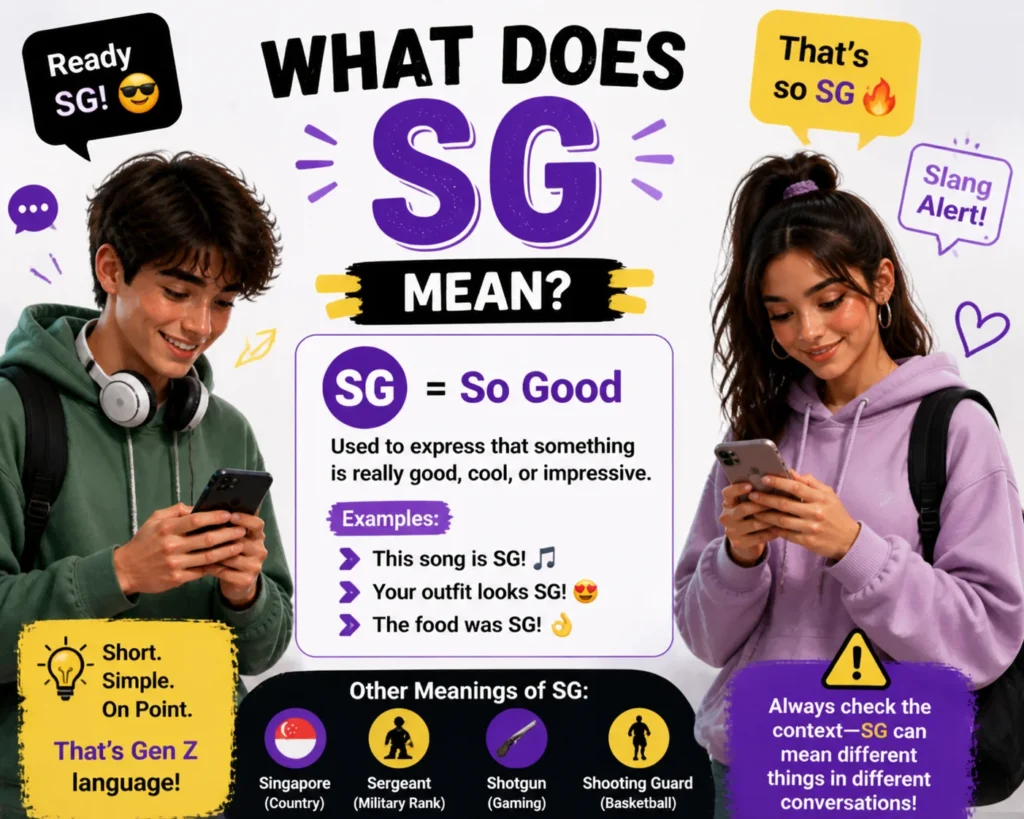
If you’ve seen the term SG floating around in texts, social media posts, or even comments and wondered what it really means, you’re not alone. SG is a slang term that has different meanings depending on the context. While it may seem like just another abbreviation, understanding its various uses can help clear up confusion.
In this article, we’ll break down what SG means, why people use it, and how to interpret it correctly in different situations. Whether you’re seeing it in a chat, a TikTok video, or a WhatsApp message, you’ll get a comprehensive understanding of how to use and respond to SG.
SG – Quick Meaning
SG is a versatile slang term that can mean different things based on the context in which it’s used. The two most common meanings of SG are:
- SG = “So Good”
- Used to express satisfaction or approval.
- Example: “This meal is SG!”
- Example: “The concert was SG!”
- SG = “Sound Good”
- Typically used to indicate agreement or to confirm that something sounds fine or acceptable.
- Example: “We’ll meet at 6 PM?”
- “SG, sounds good!”
In more specific settings, SG may have other meanings depending on the context (e.g., “sugar” in short, “special guest,” “sports game,” etc.).
Examples of SG in Context:
- Person A: “Let’s go out tonight, it’ll be fun!”
Person B: “SG! I’m in.” - Person A: “This playlist is so good, it’s SG!”
Person B: “Totally agree, I love it!” - Person A: “How was the event?”
Person B: “SG, really enjoyed it!”
These examples show how SG functions as shorthand in conversations, helping people express approval, agreement, or enthusiasm quickly and casually.
Origin & Background
The abbreviation SG has evolved from the need to communicate faster and more efficiently in the world of texting, social media, and online chats. Its usage has grown exponentially with the rise of digital communication, particularly among younger generations who are familiar with internet shorthand.
Cultural Influence:
The internet has popularized slang terms like SG, making them part of our everyday vocabulary. SG is common in various online platforms like WhatsApp, Instagram, Snapchat, and TikTok, where abbreviations help people get their messages across more quickly. As part of the fast-paced, conversational tone of social media and texting, these abbreviations have become part of the way people express their personalities and connect with others.
Social Media Impact:
On platforms like Instagram, TikTok, and Twitter, where content is constantly shared and consumed in short bursts, slang like SG helps users keep up with the rapid flow of communication. Whether it’s in a casual chat, a comment on a post, or a direct message, people use SG to quickly communicate approval or agreement, without having to write out longer phrases.
How Meaning Evolved:
Originally, SG may have been used more informally or regionally. Over time, its spread across different cultures and digital spaces has solidified its place in everyday texting and online communication. It’s now considered a standard abbreviation for expressing positive sentiment and agreement.
Real-Life Conversations
Let’s take a look at how SG might be used in real-world conversations. Here are some examples from popular messaging platforms:
Person A: “How was your day? Did you get that project done?”
Person B: “Yes! Finally done, SG!”
Person A: “That’s awesome, congrats!”
Instagram DMs
Person A: “Just posted the photo, check it out!”
Person B: “SG! You look amazing in that pic.”
Person A: “Thanks, glad you like it!”
TikTok Comments
Person A: “Who else is obsessed with this video?”
Person B: “SG, I can’t stop watching!”
Person A: “Same here, it’s hilarious!”
Text Messages
Person A: “Want to go grab lunch?”
Person B: “SG! Let’s do it!”
These real-life examples showcase how SG is used casually to communicate excitement, approval, or agreement quickly, making it a perfect addition to the fast-paced world of texting and online interaction.
Emotional & Psychological Meaning
While SG might seem like just another abbreviation, it carries emotional depth in digital conversations. By using SG, individuals express not only agreement or approval but also enthusiasm, excitement, and a shared connection.
What Emotion Does It Express?
At its core, SG expresses positivity. Whether it’s about something as simple as enjoying a meal, agreeing to a plan, or complimenting someone, SG conveys that the speaker is emotionally engaged and excited about the situation.
Why Do People Use It?
The use of SG makes communication more efficient, especially in environments where quick and casual exchanges are the norm. It also helps people maintain a friendly, positive tone in conversations without having to over-explain or elaborate.
What Does It Reveal About Modern Communication?
In modern communication, especially online, there’s a growing trend towards brevity and efficiency. People want to communicate their thoughts and feelings in the quickest way possible without losing the emotional depth of the conversation. SG is part of this trend, offering a way to express positive emotions, agreement, and excitement in just two letters.
For example, imagine a friend sends you a song they love. Instead of writing a long response, you can simply reply, “SG!” to show that you love it too. It’s quick, easy, and still conveys enthusiasm.
Usage in Different Contexts
Social Media
On platforms like Instagram and TikTok, SG is used to express approval or enthusiasm. It’s a great way to quickly respond to someone’s post, story, or video without typing out a long comment.
Example:
“SG, this filter is so cool!”
Friends & Relationships
In personal conversations, SG is used casually among friends to show agreement, excitement, or approval. It’s a simple way to convey that you like something or are on board with a plan.
Example:
Person A: “Want to hit the movies this weekend?”
Person B: “SG, I’m down!”
Work / Professional Settings
SG is generally too casual for professional settings. In work-related communication, it’s better to use complete phrases like “sounds good” or “that works for me.” Using SG in a professional environment may come off as too informal or juvenile.
Example (work-appropriate):
“Please send me the report by Friday.”
“That works for me, I’ll have it to you then.”
Casual vs Serious Tone
SG is most often used in a casual, friendly tone. It fits in conversations with close friends or on social media platforms. However, it’s not appropriate for serious discussions or formal writing, where a more detailed response is expected.
When NOT to Use It
Although SG is a fun and friendly term, it’s important to recognize situations where it may not be appropriate:
- Formal Communication: Avoid using SG in emails, formal letters, or professional environments where complete sentences and a more polished tone are expected.
- Serious Conversations: If someone is going through a tough time, responding with SG may seem dismissive or overly casual.
- Cultural Sensitivity: In some cultures or settings, using abbreviations or casual slang like SG may not be well-received. It’s always good to understand the preferences of the people you’re communicating with.
Common Misunderstandings
As with most slang, SG can sometimes be misunderstood depending on the tone and context of the conversation.
- Tone Confusion: If you send SG in response to a serious question or conversation, it may seem dismissive or out of place.
- Literal vs Figurative: SG is often used figuratively to express enthusiasm or approval. However, if taken literally, it may not make sense in a very serious discussion.
Comparison Table
| Slang | Meaning | Example Use | Similar Slang |
|---|---|---|---|
| SG | So Good / Sound Good | “This food is SG!” | GG (Good Game) |
| PFP | Profile Picture | “Change your PFP, it looks awesome!” | DP (Display Picture) |
| LOL | Laugh Out Loud | “That was hilarious, LOL!” | LMAO (Laughing My Ass Off) |
| OMG | Oh My God | “OMG, that’s amazing!” | WOW |
Key Insight:
SG is one of those slang terms that’s universally understood, yet highly context-dependent. While it conveys positivity and excitement, it’s best used in informal and friendly exchanges. When in doubt, take the time to consider the situation before using it.
Variations / Types
- SG – So Good
Used to describe something enjoyable or impressive.
“That movie was SG.” - SG – Sound Good
A way to agree or confirm plans.
“6 PM work for you? SG?” - SGI – Sounds Good Indeed
A more emphatic version of SG.
“That sounds SGI, I’m excited!” - S/G – Separation/Go
A casual shorthand used when something is going on a break or has ended.
“Looks like our chat is S/G.” - SGR – So Good Right
Used for extra emphasis.
“This song is SGR, love it!” - SGM – Sounds Good Man
An informal variant for male friends.
“SGM, let’s go.” - SGT – So Good Time
Used to express excitement about an experience.
“What a trip! It was SGT.” - SGO – So Good Online
A compliment for someone’s online presence or content.
“Your TikTok videos are SGO!” - SG2U – So Good to You
A playful way to compliment someone.
“SG2U, your new look is amazing!” - SGS – So Good Song
A phrase used to compliment a favorite song.
“This is SGS, I can’t stop listening!”
How to Respond When Someone Uses It
Casual Replies
- “SG! I loved it too.”
- “Sounds SG, let’s go for it.”
- “SG, can’t wait!”
Funny Replies
- “SG, I’m ready for this!”
- “Haha, totally SG!”
- “That’s SG for sure!”
Mature Replies
- “Yes, SG, I’m on board.”
- “Sounds like a great plan, SG.”
- “I’m glad you think so, SG.”
Respectful Replies
- “Thank you, I appreciate that. SG.”
- “That’s great to hear, SG!”
- “SG, I’m happy you liked it.”
Regional & Cultural Usage
Western Culture
In Western cultures, SG is mostly used in casual texting and on social media. Its widespread use spans both Gen Z and Millennials, especially when chatting on platforms like Snapchat, TikTok, or WhatsApp.
Asian Culture
In Asian cultures, especially in countries like India, Pakistan, and Sri Lanka, SG is commonly used to express agreement and enthusiasm in daily conversations, particularly on WhatsApp and Facebook.
Middle Eastern Culture
In Middle Eastern cultures, SG is also becoming more common, particularly on social media platforms, but people are generally more formal in their communication styles.
Global Internet Usage
Globally, SG is widely used across digital platforms, with people from different backgrounds embracing it in casual conversations.
Generational Differences (Gen Z vs Millennials)
Gen Z typically prefers shorthand abbreviations like SG, while Millennials may use the full expression “sounds good” in more formal contexts.
Is It Safe for Kids?
Yes, SG is safe for kids to use, especially in social media or casual texting situations. However, parents should monitor online interactions and ensure that slang usage is appropriate for the age group.
FAQs
- What does SG mean in texting?
SG most commonly means “So Good” or “Sounds Good.” - Is SG used in formal writing?
No, SG is informal and should be avoided in professional emails or formal communication. - How do I use SG in conversation?
Use it to express approval or agreement. Example: “This meal is SG!” - Can SG be used in a professional setting?
It’s best to avoid SG in professional or formal conversations. - What’s the difference between SG and LOL?
SG expresses approval or excitement, while LOL is used to indicate something is funny. - Is SG the same as PFP?
No, SG refers to something good or acceptable, while PFP means profile picture. - Can I use SG with anyone?
Yes, but be mindful of the context. Use it casually with friends and online, but avoid it in serious or formal discussions. - What does SG stand for in gaming?
In gaming, SG could also mean “Sound Good,” especially in agreements about in-game actions. - What does SG mean on TikTok?
On TikTok, SG typically means “So Good,” often in response to a fun or exciting video. - Is SG considered polite?
Yes, it’s a friendly and positive term but avoid overuse in formal settings.
Conclusion
SG is a flexible and positive term that helps express approval, enthusiasm, and agreement. Its simplicity and ease of use make it perfect for digital communication, whether you’re chatting with friends, commenting on social media, or making plans. However, it’s important to understand the context in which SG is used—while it’s fantastic in casual, friendly conversations, it’s not appropriate for formal or professional settings.
So, next time someone sends you a message or comment, SG! Just keep in mind the tone and context, and you’ll be speaking like a pro.