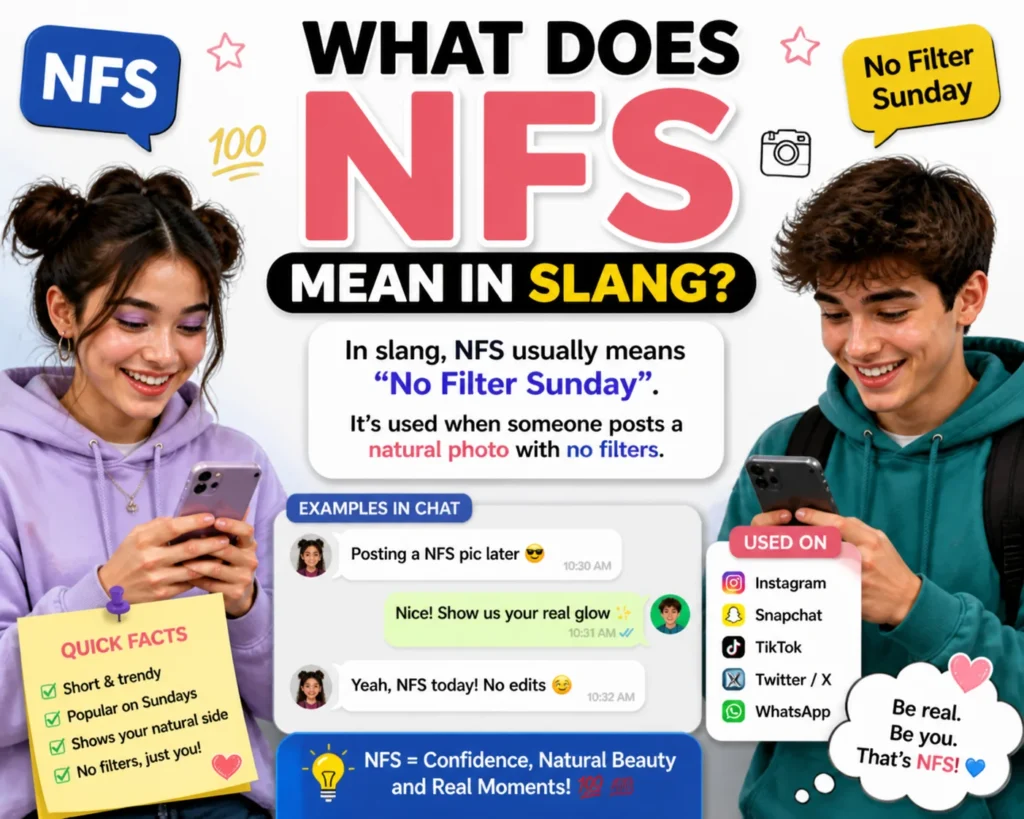
NFS in slang is an abbreviation for “Not for Sale.” It is often used in conversations to express that an item, person, or concept is unavailable or not for purchase. While it’s most commonly used in the context of online marketplaces, NFS can also appear in casual chats or social media posts to convey that something is not being offered or shared.
NFS stands for “Not for Sale.” People use it to make it clear that something is not available for purchase, but it can also be used figuratively in informal conversations. People search for this abbreviation to avoid confusion when browsing online or in texting contexts, where shorthand expressions are common.
NFS – Quick Meaning
At its core, NFS means “Not for Sale”. It’s a short and direct way to communicate that an item or service is unavailable for purchase. You’ll find this abbreviation in many online shopping platforms, classified ads, and social media posts.
Common Uses:
- “This item is NFS” – It’s not available for sale, even if it appears to be.
- “This pet is NFS, but I’m open to discussions.” – A pet or animal is not up for adoption or sale.
- “I love this bag, but it’s NFS.” – This refers to something sentimental that the person does not want to sell, such as a collectible or gift.
Quick Examples:
Person A: “Is that vintage watch for sale?”
Person B: “NFS, it’s a family heirloom.”
Person A: “Can I buy your old furniture?”
Person B: “NFS, I’m holding onto it for now.”
Person A: “I heard you’re selling that car?”
Person B: “NFS, I decided to keep it.”
Origin & Background
NFS as “Not for Sale” originated in the context of online marketplaces, where sellers needed a quick way to let potential buyers know that an item was no longer available. It is frequently seen in classified ads on websites like Craigslist, eBay, or Facebook Marketplace.
The term was adopted widely in the online commerce space, where short, efficient communication is valued. While it started as an abbreviation in selling and purchasing contexts, its usage soon spread to more general conversations, especially among younger generations who are comfortable with abbreviations in everyday interactions.
Cultural Influence
The cultural impact of abbreviations like NFS is undeniable. As texting and online conversations have become the norm, more people are shortening their communication. NFS became a staple because it is short, precise, and communicates important information quickly.
The influence of social media has expanded NFS’s reach even further. On platforms like Instagram, users often write “NFS” when sharing pictures of their possessions, such as clothing, collectibles, or pets, to indicate that they aren’t for sale. It can also show that something is valuable, sentimental, or irreplaceable, not meant for trade.
For instance, you might see a post like:
“My old guitar collection, NFS, but I love sharing my journey with you all.”
This not only informs others that the collection isn’t for sale but also adds an emotional layer to the post, revealing the value placed on the collection beyond monetary worth.
Real-Life Conversations
Let’s dive into some realistic conversations that show how NFS is used in texting, WhatsApp, and Instagram DMs.
WhatsApp Conversation
Person A: “Hey, is that old car still up for sale?”
Person B: “NFS. I’ve decided to keep it for now.”
In this conversation, Person B uses NFS to let Person A know that the car is no longer for sale.
Instagram DM
Person A: “I love that handbag, is it available for purchase?”
Person B: “NFS, it’s a gift from my mom.”
Here, Person B clarifies that the handbag isn’t for sale by tagging it with NFS, emphasizing its sentimental value.
Text Message
Person A: “Can I buy your old video games?”
Person B: “NFS, I’m holding onto them.”
In this case, Person B uses NFS to politely inform Person A that the games are not for sale, possibly because they hold sentimental value.
TikTok Comment
Person A: “Is that vintage watch for sale?”
Person B: “NFS, it’s a family heirloom.”
On platforms like TikTok, NFS can be used to respond to people’s inquiries about items shown in videos, providing a quick and clear answer.
Emotional & Psychological Meaning
Emotionally, NFS often signals that the person values the item beyond its monetary worth. When something is marked as NFS, it often indicates sentimentality, attachment, or exclusivity. This gives the item a sense of emotional value, rather than just a transactional one.
People use NFS to express that while the object might be attractive to others, it holds a deeper connection to the owner. It’s a subtle way of signaling that what’s mine isn’t for sale. This taps into human nature’s need for ownership, sentiment, and personal connections.
Personal Example:
Imagine texting a friend who asks if they can buy your old gaming console.
You: “I love this thing, but it’s NFS. It holds too many memories.”
Here, you’re using NFS to gently let them know that the console holds value for you beyond what it’s worth financially, emphasizing the emotional connection you have to it.
Usage in Different Contexts
Social Media
On social media platforms like Instagram, Facebook, and Twitter, NFS is used when users want to show something they own but make it clear that they are not selling it. It can refer to:
- Collectibles – Like comic books, action figures, or limited-edition items.
- Pets – Someone showing their pet and noting that they are not selling it.
- Sentimental items – Such as family heirlooms or gifts that hold personal value.
Friends & Relationships
In conversations with friends, NFS is often used to communicate that an item or even a piece of information isn’t up for negotiation. It can also help avoid awkward conversations about potential sales or trades.
For example, NFS may be used in:
- Gift exchanges to signal that something given is not up for trade.
- Personal projects or hobbies where people share their creations but clarify they are not selling them.
Work / Professional Settings
NFS is less common in professional settings unless discussing items for sale, such as in an office sale event, a business meeting, or within a professional network where transactions may take place.
For instance:
Person A: “Can I buy your old office chair?”
Person B: “NFS, but I can recommend a good brand.”
In the workplace, NFS helps communicate boundaries about personal items or things that are not intended for sale.
Casual vs Serious Tone
The tone of NFS is typically casual and nonchalant. It signals that the item is not available but isn’t a serious rejection. However, if the context involves more serious emotional attachment (e.g., family heirlooms or personal mementos), the tone might shift to one of protection and ownership.
In informal chats with friends or online communities, NFS can be used more lightheartedly. In contrast, when used regarding personal possessions with deep sentimental value, it can reflect a stronger sense of protection.
When NOT to Use It
- In sensitive situations: When discussing emotional matters or offering items to others, avoid using NFS unless you feel comfortable with the person.
- In professional settings: NFS is too casual for formal or corporate settings.
- When the item is available for sale: NFS can confuse people if they actually want to purchase the item but you aren’t clear about whether it’s really off-limits.
- In cross-cultural contexts: Ensure that NFS doesn’t unintentionally give off a message of coldness or exclusion, especially in cultures where generosity is valued.
Common Misunderstandings
What People Get Wrong
Some people misunderstand NFS as a hard no, while it might simply be a casual way of stating that something is not available for sale.
- Tone confusion: People may mistake NFS for a more serious or permanent rejection when, in reality, it’s simply a way of stating availability.
- Literal vs figurative meaning: NFS can also be used to describe something that isn’t for sale but still holds value for someone. It doesn’t always mean that the person is unwilling to part with the item forever.
Tone Confusion
Without context, NFS might sound like an abrupt “no” rather than a clear explanation that the item simply isn’t for sale. For example, if someone says:
Person A: “Can I buy your car?”
Person B: “NFS, sorry.”
That could sound like Person B is refusing to sell the car, even if they just didn’t want to sell it at that moment.
Comparison Table
| Term | Meaning | Usage Context | Tone | Popularity |
|---|---|---|---|---|
| NFS | Not for sale | Online shopping, personal items, social media | Casual, direct | Very common in social media |
| FS | For sale | Buying and selling items | Transactional, serious | Very common in classified ads |
| N/A | Not available | General unavailability | Neutral | Used widely in professional settings |
| TBD | To be determined | Pending decisions | Neutral | Common in professional or official communication |
Key Insight:
NFS is primarily about communication. While it’s widely used in casual settings to mark an item’s unavailability, it’s also important to consider how the tone might be received—whether it’s viewed as an abrupt refusal or a casual statement of fact.
Variations / Types
- NFS (Not for Sale) – Standard usage for items unavailable for purchase.
- N/A (Not Available) – Used when something isn’t accessible or available.
- Not for Trade – Similar to NFS, indicating the item is unavailable for trading.
- Not Negotiable – Often used to signify that the price or terms of sale are fixed.
- FS (For Sale) – The opposite of NFS, indicating availability.
- PM for Price – Private message requested for discussing pricing.
- OBO (Or Best Offer) – Indicating flexibility in price, used with items for sale.
- Free to a Good Home – Common in pet or item adoption contexts.
- Pre-order Only – Available for purchase, but not yet in stock.
- SOLD – Used when an item has already been sold, making it unavailable.
How to Respond When Someone Uses It
Casual Replies
- “Got it, no worries.”
- “Cool, thanks for letting me know.”
- “Understood, I’ll keep looking.”
Funny Replies
- “I guess I’ll have to wait for your next garage sale.”
- “No problem, I’ll keep an eye out for the next one.”
- “I thought it was too good to be true!”
Mature Replies
- “I completely understand, thanks for the clarification.”
- “I respect that, no problem at all.”
- “That’s fair, I’ll keep searching.”
Respectful Replies
- “Thank you for letting me know.”
- “I appreciate the heads-up.”
- “Thanks for clearing that up.”
Regional & Cultural Usage
Western Culture
In the US and UK, NFS is widely understood, particularly in online sales communities like Facebook Marketplace and Craigslist.
Asian Culture
In countries like India, Japan, and China, NFS is understood, especially by younger internet users familiar with global trends. However, it may not be as widely used as in Western countries.
Middle Eastern Culture
In regions like the UAE and Saudi Arabia, NFS is understood in online shopping contexts, though more formal language is often preferred for professional transactions.
Global Internet Usage
NFS has become a universal term in online communication, especially in classified ads and casual social media posts, connecting people worldwide who wish to mark something as unavailable for purchase.
Generational Differences
Younger generations, particularly Gen Z, use NFS more casually in texts and social media, while older generations may prefer more formal language in their transactions.
Is It Safe for Kids?
Yes, NFS is safe for kids to use, especially in non-commercial contexts. However, younger children may not fully understand the concept of transactions or the emotional significance of NFS when referring to personal items.
FAQs
What does NFS mean in slang?
NFS stands for “Not for Sale” and is used to indicate that an item is not available for purchase.
Can NFS be used for pets?
Yes, NFS is often used when referring to pets that are not for adoption or sale.
Is NFS rude?
No, NFS is not inherently rude. It’s a straightforward way of letting someone know something is unavailable.
Can NFS be used in professional settings?
It’s best to avoid using NFS in professional settings. More formal language is typically preferred in business transactions.
Does NFS always mean “not for sale”?
While NFS typically means “Not for Sale,” it can sometimes be used figuratively to indicate that something is unavailable or not open for negotiation.
How can I respond to NFS?
A casual or respectful reply works best, such as, “Got it, no problem” or “I understand, thanks!”
Can NFS be used for sentimental items?
Yes, NFS is often used to describe personal items with sentimental value that are not intended for sale.
How is NFS used on social media?
On social media, NFS is used to indicate that an item shown in a post or story is not for sale.
Is NFS used in texting?
Yes, NFS is commonly used in texting, especially when someone is clarifying that something is not for sale.
Conclusion
NFS is a simple but impactful slang term that carries a clear message of unavailability. Whether used in online sales, social media posts, or casual conversations, it helps set boundaries and manage expectations. Understanding when and how to use NFS ensures smooth communication, avoiding confusion, and helping maintain clarity in transactions and personal conversations.