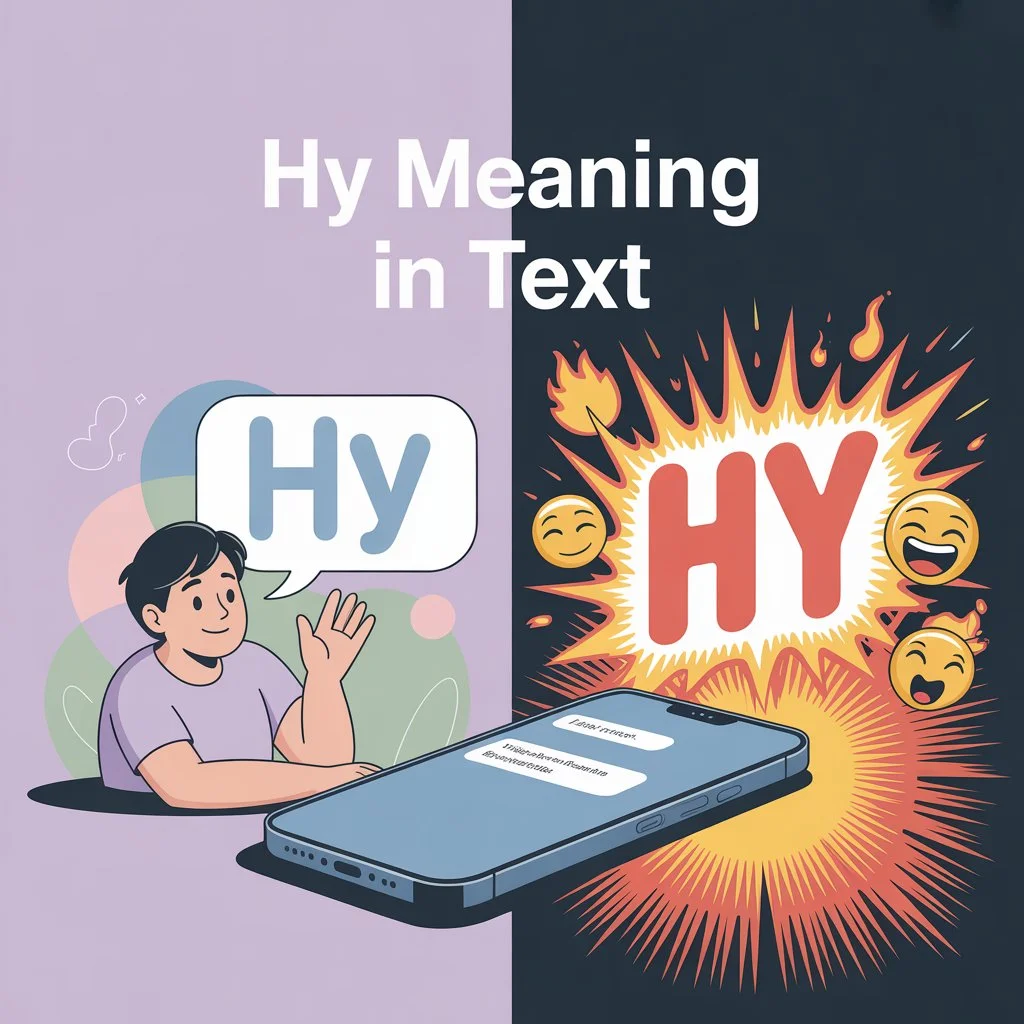
“HY” in a text usually means “Hell Yes” or simply “Hi/Hey,” depending on context. That’s why people get confused—it can signal excitement, agreement, or just a casual greeting. Understanding tone and situation makes all the difference.
If you’ve ever received a quick “HY” and wondered what the sender really meant, you’re not alone. It’s one of those short replies that feels simple—but carries multiple meanings depending on who sends it and how.
What Does HY Mean in a Text – Quick Meaning
HY = “Hell Yes” or “Hi/Hey”
- “Hell Yes” → Strong excitement or agreement
- “Hi/Hey” → Casual greeting, often in fast typing
Examples:
- “Want to go out tonight?” → “HY 🔥”
- “HY, what are you doing?”
- “Movie tonight?” → “HY!!!”
The tone is everything. One version feels energetic, the other just friendly.
Origin & Background
“HY” comes from the natural habit of shortening words in digital conversations.
As texting evolved, people began trimming phrases to save time. “Hey” became “hy.” At the same time, expressive phrases like “Hell Yes” were shortened to match fast-paced chats.
Social media platforms—especially Snapchat, Instagram, and texting apps—pushed this trend even further. The goal isn’t perfect grammar. It’s speed, mood, and connection.
Over time, “HY” became a dual-meaning shortcut, shaped by context instead of strict definition.
Real-Life Conversations
WhatsApp Chat
Person A: Want to order pizza?
Person B: HY, I’m starving
Instagram DMs
Person A: HY, long time no talk
Person B: Hey! Yeah, it’s been a while
TikTok Comments
Person A: Should I try this trend?
Person B: HY do it 😂
Text Messages
Person A: Are you coming to the party?
Person B: HY!!! I wouldn’t miss it
These examples show how “HY” shifts naturally between greeting and excitement without anyone needing to explain it.
Emotional & Psychological Meaning
“HY” might look small, but it carries emotional weight.
When used as “Hell Yes,” it expresses:
- Excitement
- Enthusiasm
- Strong agreement
When used as “Hi/Hey,” it shows:
- Casual friendliness
- Openness to conversation
- Low-pressure communication
What’s interesting is how it reflects modern texting habits. People don’t always want to write long responses. They want something quick that still feels human.
Personal Scenario
A friend once asked me, “Are you finally free this weekend?” I replied with “HY!!!”
That one message instantly set the tone. It showed excitement without needing a full sentence. That’s the power of short-form language—it communicates emotion faster than words sometimes.
Usage in Different Contexts
Social Media
On platforms like Snapchat or Instagram, “HY” is common and natural.
Example:
“HY this is so funny 😂”
Friends & Relationships
Among friends, it feels relaxed and expressive.
Example:
“HY let’s meet today”
Work / Professional Settings
Avoid using “HY” here. It can feel too casual or unclear.
Better alternative:
“Yes, absolutely” or “Hello”
Casual vs Serious Tone
- Casual: “HY, what’s up?”
- Excited: “HY!!! let’s go”
- Serious: Not recommended
Context decides everything.
When NOT to Use It
Avoid “HY” in:
- Formal emails
- Job-related communication
- Academic writing
- Professional meetings (even in chat)
- Sensitive conversations
Also, if the person isn’t familiar with slang, it may confuse them.
Common Misunderstandings
1. Assuming one fixed meaning
“HY” doesn’t always mean the same thing.
2. Misreading tone
A simple “HY” can feel cold if someone expected enthusiasm.
3. Confusing it with “Hey” only
Sometimes it’s much stronger—like “Hell Yes.”
4. Overthinking it
In many cases, it’s just quick, casual communication.
Comparison Table
| Expression | Meaning | Tone | Usage |
|---|---|---|---|
| HY | Hell Yes / Hi | Flexible | Casual texting |
| Hey | Greeting | Neutral | Everyday use |
| YES | Agreement | Clear | General |
| Yesss | Excited agreement | Energetic | Informal |
| IDK | I don’t know | Uncertain | Casual |
Key Insight
“HY” stands out because it blends emotion and efficiency. It’s not just what you say—it’s how quickly and lightly you say it.
Variations / Types
- HY!! – Strong excitement
- HY!!! – Extreme enthusiasm
- hy – Soft, casual greeting
- Hy 🙂 – Friendly and warm
- HY lol – Playful agreement
- HY fr – Genuine excitement
- HY rn – Immediate agreement
- HY yeah – Reinforced yes
- HY ok – Slightly toned-down response
- HY🔥 – Confident, energetic vibe
Each variation shifts the emotional tone slightly.
How to Respond When Someone Uses It
Casual Replies
- “Nice, let’s do it”
- “Cool, I’m in too”
Funny Replies
- “Okay calm down 😂”
- “That’s a lot of energy lol”
Mature Replies
- “Great, I’ll make the arrangements”
- “Sounds good, see you then”
Respectful Replies
- “Thank you for confirming”
- “Appreciate your response”
Regional & Cultural Usage
Western Culture
Common among younger users. Frequently used in casual texting and social media.
Asian Culture
Less common in formal settings. Used mostly by younger, internet-savvy users.
Middle Eastern Culture
Seen among English-speaking youth, but not widely used across all age groups.
Global Internet Usage
“HY” is part of a broader trend of short-form slang that prioritizes speed and emotional tone.
Generational Differences
- Gen Z: Uses it naturally and often
- Millennials: Understand it but may prefer full words
- Older Generations: May find it unclear or unnecessary
Is It Safe for Kids?
Yes, “HY” is safe and harmless.
However, kids should learn when to switch to clearer language—especially in school or formal communication.
FAQs
1. What does HY mean in texting?
It usually means “Hell Yes” or “Hi/Hey,” depending on context.
2. Is HY rude?
No, but it can feel too casual in serious situations.
3. Does HY always mean excitement?
Not always. It can also be a simple greeting.
4. Can I use HY in professional messages?
It’s better to avoid it and use full words instead.
5. Why do people use HY?
To communicate quickly while still expressing tone or emotion.
6. Is HY the same as “Hey”?
Sometimes, but not always—it can also mean strong agreement.
7. How do I know which meaning is intended?
Look at the context, tone, and punctuation (like “HY!!!”).
Conclusion
“HY” is a perfect example of how modern communication works—short, flexible, and full of subtle meaning.
Sometimes it’s just a quick “hey.” Other times, it’s pure excitement packed into two letters.
The key is to read the moment, not just the message. Once you do, “HY” becomes easy to understand—and even easier to use naturally.