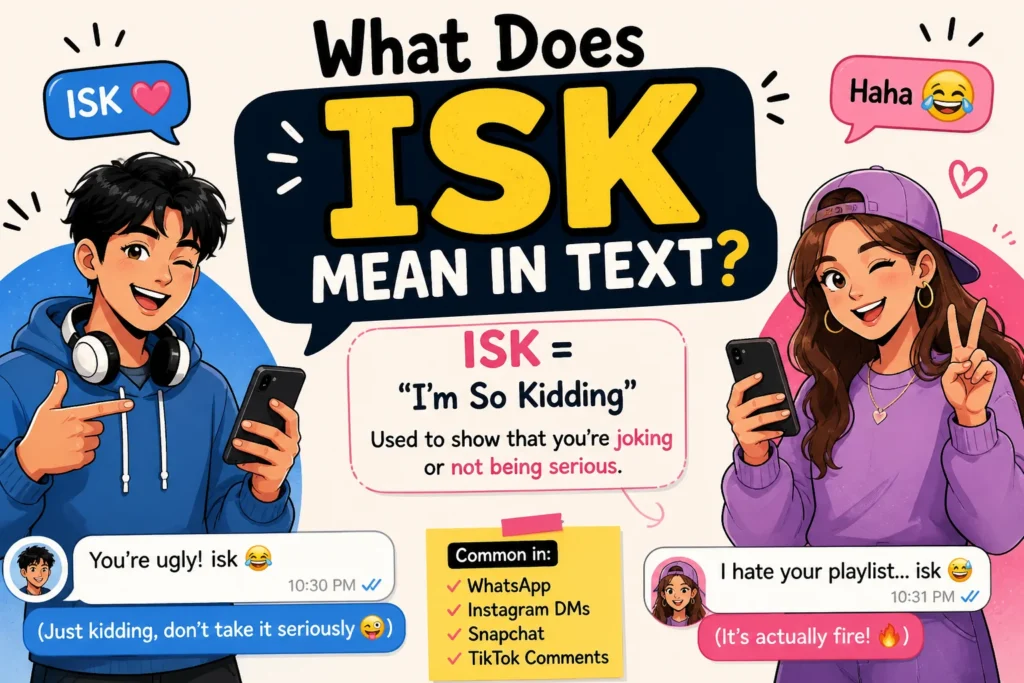
“ISK” in text usually means “I’m so kidding” or “I’m just kidding,” though in some contexts it can also stand for “I swear, okay” or be a typo/slang variation. People search this because the meaning changes based on tone, platform, and conversation style—leading to confusion, especially in fast-paced chats.
If you’ve ever paused mid-conversation wondering whether someone was serious or joking, you’re not alone. Slang like “ISK” lives in that gray area where context matters more than the letters themselves.
What Does “ISK” Mean in Text – Quick Meaning
At its core, “ISK” is informal slang used to soften or clarify tone.
Common meanings:
- “I’m so kidding” – used to show a statement was a joke
- “I’m just kidding” (variant) – similar tone clarification
- Occasionally “I swear, okay” – rare and context-specific
Simple examples:
- “You’re the worst at replying 😂 isk”
- “I hate you… isk, don’t take it seriously”
- “That was rude—isk, I’m joking”
Think of it as a quick emotional correction button in digital conversation.
Origin & Background
“ISK” doesn’t have a single clear origin like some older slang terms. Instead, it emerged organically through texting culture and abbreviation habits.
In early SMS days, people shortened phrases to save time and character limits. Over time, platforms like WhatsApp, Instagram, and TikTok accelerated this trend.
How it evolved:
- Phase 1: Long phrases (“I’m just kidding”)
- Phase 2: Shortened versions (“jk”)
- Phase 3: Experimental slang (“isk”)
Unlike “jk,” which is widely recognized, “isk” feels more niche and personal, often used within friend groups or specific online communities.
Social media played a big role. Fast replies, humor-driven communication, and meme culture all pushed users to create variations that feel more expressive or unique.
Real-Life Conversations
Here’s how “isk” actually shows up in everyday chats:
WhatsApp Chat
Person A: You forgot my birthday 😒
Person B: Wait what??
Person A: isk 😂 just testing you
Instagram DMs
Person A: You looked so awkward in that reel 😭
Person B: Wow thanks
Person A: isk you were cute actually
TikTok Comments
Person A: This dance is cringe
Person B: Then why are you watching?
Person A: isk it’s kinda addictive
Text Messages
Person A: I’m never talking to you again
Person B: What happened??
Person A: isk calm down 😭
These examples show how “isk” often rescues a message from being taken too seriously.
Emotional & Psychological Meaning
“ISK” is more than slang—it’s emotional signaling.
It often expresses:
- Playfulness
- Sarcasm
- Light teasing
- Emotional safety
In digital communication, tone is easy to misread. Without facial expressions or voice, people rely on shortcuts like “isk” to prevent conflict.
Why people use it:
- To avoid hurting someone’s feelings
- To maintain humor without risk
- To soften blunt statements
A real-life scenario:
You tease a close friend: “You’re so annoying.”
Immediately, you feel they might take it the wrong way. Adding “isk” reassures them: this is playful, not serious.
It reflects a deeper shift in communication—people want to be expressive without emotional consequences.
Usage in Different Contexts
Social Media
Used casually in comments, captions, or replies. Often paired with emojis.
Example:
“That outfit is terrible isk 😭”
Friends & Relationships
Very common. Helps maintain a playful tone in close connections.
Example:
“You’re the worst best friend isk”
Work / Professional Settings
Not recommended. It can appear confusing or unprofessional.
Instead, use clear language like:
“Just joking” or “That was meant humorously.”
Casual vs Serious Tone
- Casual: Works well
- Serious conversations: Can feel dismissive or insensitive
Tone matters more than the word itself.
When NOT to Use It
Avoid “isk” in situations where clarity and respect are essential:
- Formal communication
- Serious discussions (arguments, emotional topics)
- With people unfamiliar with slang
- Cross-cultural conversations where meaning may be unclear
Using it at the wrong time can make you seem insincere or dismissive.
Common Misunderstandings
1. Thinking it always means “I swear”
In most cases, it doesn’t. That interpretation is rare.
2. Confusing it with “jk”
While similar, “isk” feels more informal and less widely understood.
3. Taking it literally
It’s not about the words—it’s about tone correction.
4. Missing the emotional cue
Sometimes people use “isk” to avoid confrontation rather than just joke.
Comparison Table
| Expression | Meaning | Tone | Usage |
|---|---|---|---|
| ISK | I’m so kidding | Playful, soft | Casual chats |
| JK | Just kidding | Direct, clear | Widely used |
| LOL | Laughing out loud | Light humor | Universal |
| SRSLY | Seriously | Emphasis | Casual |
| IDC | I don’t care | Blunt | Risky tone |
Key Insight
“ISK” stands out because it feels more personal and less standardized than other slang. It carries subtle emotional nuance rather than just meaning.
Variations / Types
Here are common variations and related forms:
- ISK 😂 – Adds humor emphasis
- iskkk – Extended for dramatic tone
- ISK bro – Friendly reassurance
- isk relax – Calming tone
- isk don’t worry – Emotional reassurance
- isk lol – Reinforces humor
- isk fr – Blends joking with slight truth
- isk chill – Softens tension
- isk I swear – Mixed tone (confusing sometimes)
- isk haha – Light teasing
Each variation slightly changes emotional delivery.
How to Respond When Someone Uses It
Casual Replies
- “You scared me for a second 😭”
- “Okay good 😂”
Funny Replies
- “Too late, I already cried”
- “Emotional damage done”
Mature Replies
- “Got it, thanks for clarifying”
- “Haha, I figured”
Respectful Replies
- “No worries, I understand”
- “All good, thanks for explaining”
Your response depends on how well you know the person.
Regional & Cultural Usage
Western Culture
More common in informal texting among Gen Z. Seen as playful and experimental slang.
Asian Culture
Less widely used. People may prefer clearer expressions like “jk” or emojis.
Middle Eastern Culture
Understanding varies. Some may misinterpret it due to language differences.
Global Internet Usage
Still niche. Not universally recognized like “LOL” or “BRB.”
Generational Differences
- Gen Z: More likely to use and understand it
- Millennials: May find it confusing or unnecessary
Is It Safe for Kids?
Yes, generally. “ISK” is harmless slang used for humor clarification.
However, context matters. Kids should understand when joking is appropriate and how tone can affect others.
FAQs
1. What does ISK mean in texting?
It usually means “I’m so kidding” or “I’m just kidding.”
2. Is ISK the same as JK?
Similar, but “JK” is more widely understood and clearer.
3. Can ISK mean something else?
Rarely, it may mean “I swear, okay,” depending on context.
4. Is ISK commonly used?
Not as common as other slang; it’s more niche.
5. Should I use ISK in professional messages?
No, it’s too informal and can confuse readers.
6. Why do people use ISK instead of JK?
To sound more unique or expressive.
7. Is ISK rude?
No, but it can seem dismissive if used at the wrong time.
8. How do I know what ISK means in a message?
Look at tone, emojis, and context of the conversation.
9. Can ISK be misunderstood?
Yes, especially by people unfamiliar with slang.
10. Is ISK a typo?
Sometimes, but often it’s intentional slang.
Conclusion
“ISK” is a small word with a big role—it helps people balance humor and clarity in fast, emotional digital conversations.
It reflects how modern communication isn’t just about words, but about tone, timing, and emotional awareness.
Use it when the moment feels light. Avoid it when clarity matters more than style. And most importantly, trust your instinct—because good communication is less about slang and more about understanding the person on the other side.