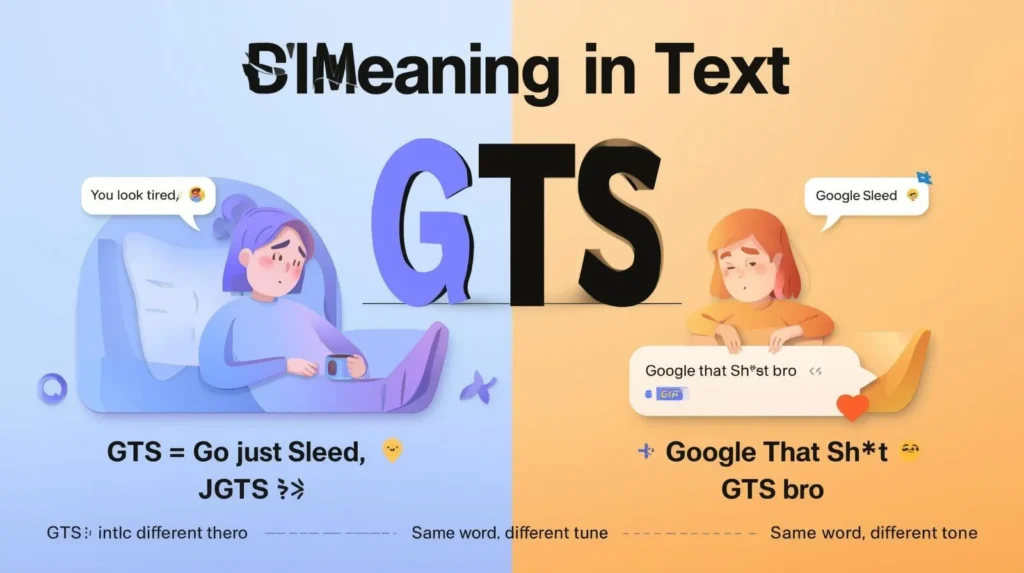
“GTS” in text usually means “Go to Sleep,” but it can also mean “Google That Sh*t” depending on context. People search this phrase because it appears in messages with completely different tones—sometimes caring, sometimes sarcastic—and that confusion leads to misinterpretation.
In today’s messaging culture, short abbreviations like “GTS” carry emotional weight. One person might mean “rest well,” while another is saying “look it up yourself.” Understanding the context changes everything.
GTS Mean in Text – Quick Meaning
“GTS” has two primary meanings:
- Go To Sleep → A caring or slightly dismissive suggestion to rest
- Google That Sh*t → A blunt or sarcastic way to tell someone to search for information
Examples:
- “You’ve been up all night, GTS 😴”
- “Stop overthinking and GTS, you need rest”
- “I’m not explaining again… GTS 🙄”
Origin & Background
“GTS” emerged during early texting and online chatroom culture when abbreviations became essential for speed.
“Go to sleep” was commonly shortened in late-night chats, especially among friends and couples. It carried a soft, caring tone.
Later, internet culture—particularly forums and meme communities—introduced the sharper meaning: “Google that sh*t.” This version reflects the rise of self-service knowledge and a slightly impatient digital attitude.
As platforms like Twitter, Reddit, and TikTok grew, both meanings started coexisting. Now, “GTS” is a perfect example of how slang evolves with tone, not just definition.
Real-Life Conversations
WhatsApp Chat
Person A: I haven’t slept in 24 hours
Person B: Seriously, GTS now. Your body needs it
Instagram DMs
Person A: What’s the capital of Canada again?
Person B: Bro… GTS 😭
TikTok Comments
User 1: Why does this trend even exist?
User 2: idk man, GTS and stop stressing 😂
Text Message
Person A: I keep thinking about what she said
Person B: It’s late… GTS. Things feel clearer in the morning
Emotional & Psychological Meaning
“GTS” reflects more than just words—it reveals intent and emotional tone.
When used as “Go to sleep,” it often carries:
- Care
- Concern
- Gentle authority
When used as “Google that sh*t,” it expresses:
- Frustration
- Impatience
- Sarcasm
This dual nature shows how modern communication relies heavily on context and relationship dynamics.
Personal-style scenario:
I once texted a friend late at night, overthinking something small. Their reply was simple: “GTS.”
At first, it felt dismissive. But I realized later—it was actually care disguised as brevity. They knew I needed rest, not more analysis.
That’s the complexity of “GTS.” It’s short, but emotionally layered.
Usage in Different Contexts
Social Media
On platforms like TikTok or Instagram:
- “GTS 😴” = supportive, calming
- “GTS lol” = sarcastic or dismissive
Friends & Relationships
Among close friends:
- Can feel caring or teasing
- Tone depends on timing and mood
Work / Professional Settings
Avoid using “GTS.”
It can sound:
- Unprofessional
- Rude
- Confusing
Instead, use clear language like “Please check online” or “Get some rest.”
Casual vs Serious Tone
- Casual: flexible and widely used
- Serious: may come off as insensitive if misunderstood
When NOT to Use It
Avoid “GTS” in these situations:
- Emotional conversations (can feel dismissive)
- Formal communication (emails, workplace chats)
- With strangers (tone may be misread)
- Serious discussions where clarity matters
Using it in the wrong moment can damage tone and trust.
Common Misunderstandings
1. Assuming it always means “Go to sleep”
Many people miss the sarcastic version entirely.
2. Misreading tone
Without emojis or context, it can feel rude—even when it’s not.
3. Cultural confusion
Not everyone is familiar with both meanings, especially outside Western internet culture.
Comparison Table
| Expression | Meaning | Tone | Usage |
|---|---|---|---|
| GTS | Go to sleep / Google that sh*t | Caring or sarcastic | Informal |
| BRB | Be right back | Neutral | Casual |
| IDK | I don’t know | Neutral | Universal |
| Look it up | Search yourself | Direct | Semi-formal |
| Sleep well | Rest properly | Caring | Universal |
Key Insight
“GTS” stands out because it combines care and sarcasm in one abbreviation. That dual meaning makes it powerful—but also easy to misunderstand without context.
Variations / Types
- GTS 😴 – Clearly means go to sleep
- GTS lol – Light sarcasm
- GTS bro – Casual tone
- GTS now – Slight urgency
- GTS pls – Softer suggestion
- GTS fr – Serious advice
- GTS 😂 – Playful dismissal
- GTS asap – Strong urgency
- GTS man – Friendly tone
- GTS and chill – Relaxation suggestion
How to Respond When Someone Uses It
Casual Replies
- “Yeah, I probably should 😅”
- “Alright, heading to bed”
Funny Replies
- “Sleep is optional 😤”
- “My brain said no 😂”
Mature Replies
- “You’re right, I need rest”
- “I’ll look it up, thanks”
Respectful Replies
- “Got it, I understand”
- “Thanks for the suggestion”
Regional & Cultural Usage
Western Culture
Widely understood in both meanings. Tone depends on context and relationship.
Asian Culture
Less commonly used. “Go to sleep” meaning is easier to understand than the sarcastic version.
Middle Eastern Culture
Used among English-speaking youth, but sarcasm may be interpreted more strongly.
Global Internet Usage
Meaning shifts based on platform:
- Reddit → “Google that sh*t”
- TikTok → “Go to sleep”
- Messaging apps → mixed usage
Generational Differences
Gen Z:
- Comfortable switching meanings
- Uses it playfully and frequently
Millennials:
- More likely to use it as “Go to sleep”
- Slightly more cautious with tone
Is It Safe for Kids?
Partially.
- “Go to sleep” → completely safe
- “Google that sh*t” → contains mild profanity
Parents should guide children on context and tone, especially around respectful communication.
FAQs
1. What does GTS mean in texting?
It usually means “Go to sleep” or “Google that sh*t,” depending on context.
2. Is GTS rude?
It can be if used sarcastically, especially without emojis or friendly tone.
3. What does GTS mean on TikTok?
Mostly “Go to sleep,” often used humorously or supportively.
4. Can GTS be caring?
Yes, when used to suggest rest or concern for someone’s well-being.
5. Should I use GTS at work?
No, it’s too informal and can be misunderstood.
6. Why is GTS confusing?
Because it has two very different meanings with opposite tones.
7. Is GTS popular slang?
Yes, especially among younger users and online communities.
Conclusion
“GTS” is a small phrase with a surprisingly big emotional range. It can comfort someone, tease a friend, or shut down a conversation—all in just three letters.
The difference lies in context, tone, and relationship.
Once you understand those layers, “GTS” becomes easy to interpret—and even easier to use naturally. Like most modern slang, it’s not just about what you say, but how and when you say it.
Use it thoughtfully, and it becomes a powerful part of everyday communication.