
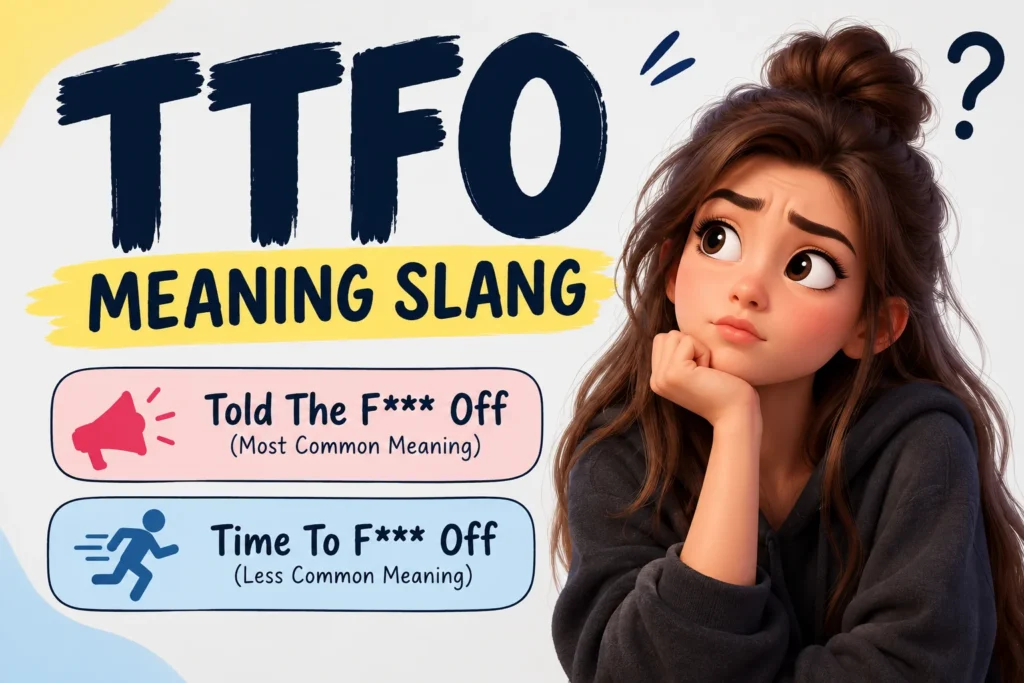
TTFO meaning slang most commonly stands for “Told The F* Off,”** describing someone who was harshly scolded, insulted, or firmly put in their place. In some online conversations, it can also mean “Time To F* Off,”** though this usage is much less common and heavily depends on context.
Many people search for TTFO meaning slang after spotting it in a text message, TikTok comment, Snapchat chat, or gaming conversation. Because it contains profanity and has more than one interpretation, it can be confusing without understanding the surrounding context.
What Does TTFO Mean in Slang?
TTFO is an internet acronym that includes profanity, making it suitable only for informal conversations. Unlike common abbreviations such as LOL or BRB, TTFO is usually used when someone wants to describe a confrontation, dismissal, or blunt interaction.
The intended meaning almost always depends on the conversation.
TTFO = Told The F*** Off (Most Common Meaning)
The most widely recognized meaning of TTFO is “Told The F* Off.”**
People use it when someone has been aggressively corrected, yelled at, rejected, or firmly told to leave or stop doing something. It often appears when discussing arguments, online drama, workplace conflicts, or personal disagreements.
Example:
A: What happened when he interrupted the meeting again?
B: He got TTFO by the manager.
In this example, TTFO means the person was harshly reprimanded.
Another example:
“Don’t argue with the moderator unless you want to get TTFO.”
Here, the speaker warns that disrespectful behavior will likely result in a strong verbal response.
TTFO = Time To F*** Off (Less Common)
A less common interpretation is “Time To F* Off.”**
This version is typically used as a blunt way of telling someone it’s time to leave, stop bothering others, or end a conversation.
Example:
“You’ve pushed your luck. TTFO.”
Because this interpretation functions almost like a command, it’s generally more offensive than the first meaning.
Is TTFO an Acronym, Abbreviation, or Slang?
TTFO is best described as:
- Type: Acronym
- Category: Internet slang abbreviation
- Contains profanity: Yes
- Formality: Very informal
It isn’t appropriate for formal communication because both common meanings include explicit language.
TTFO Meaning Across Different Platforms
The meaning remains generally consistent, but the way people use TTFO differs depending on the platform.
TTFO on TikTok
On TikTok, TTFO most often appears in comments reacting to videos involving arguments, confrontations, or embarrassing moments.
Example:
“Bro really got TTFO during the livestream 😭”
Users often pair it with laughing or shocked emojis to emphasize how intense the situation was.
TTFO on Instagram
Instagram users occasionally use TTFO in comment sections discussing celebrity drama, sports debates, or viral clips where someone receives public criticism.
Example:
“He thought he won the argument but got TTFO.”
Its use is less common in captions and more frequent in replies.
TTFO on Snapchat
Snapchat conversations are one of the most natural places for TTFO because chats between friends often involve storytelling about school, work, or relationships.
Example:
A: Did your brother keep arguing?
B: Yeah… Mom TTFO him.
The abbreviation keeps the conversation short while still expressing the intensity of the situation.
TTFO on WhatsApp
WhatsApp group chats sometimes use TTFO when friends discuss everyday disagreements or humorous incidents.
Example:
“The referee TTFO everyone arguing.”
It’s mainly used among people already familiar with internet slang.
TTFO on X (Formerly Twitter)
TTFO appears occasionally on X, particularly in sports discussions, political debates, or reactions to trending news.
Example:
“He tried trolling everyone and immediately got TTFO.”
Because posts are short, abbreviations like TTFO help users express reactions quickly.
Tone and Context Variations
Although TTFO usually refers to confrontation, the emotional tone changes depending on the speaker and situation.
Funny
A: Did your dad catch you sneaking snacks?
B: Yep.
A: What happened?
B: I got TTFO and lost dessert too.
Here, TTFO is used humorously to exaggerate a harmless family moment.
Sarcastic
A: So you ignored everyone’s advice again?
B: Maybe.
A: And then?
B: Naturally, I got TTFO.
The speaker uses sarcasm to admit they ignored obvious warnings.
Playful
A: I challenged my older sister to a video game.
B: Brave.
A: She TTFO me in five minutes.
In this example, TTFO jokingly describes being completely defeated rather than literally scolded.
Serious
A: Why did he leave the meeting early?
B: The boss TTFO him in front of everyone.
A: That must’ve been embarrassing.
This usage reflects an actual workplace confrontation.
Real Chat Examples
1. Friends After School
A: Why was Jake so quiet today?
B: He got TTFO by the coach.
A: Seriously?
B: Yeah, for showing up late again.
2. Gaming Voice Chat
A: Why did Alex leave the server?
B: He kept trash-talking everyone.
A: Then what?
B: The admin TTFO before banning him.
3. Snapchat Conversation
A: Did your sister ever tell your parents?
B: Yep.
A: How’d that go?
B: I got TTFO immediately.
4. Workplace Friends
A: Why did that meeting end so fast?
B: One employee interrupted the manager.
A: Ouch.
B: He got TTFO in front of the whole team.
5. College Group Chat
A: Did the professor notice the copied assignment?
B: Definitely.
A: What happened?
B: The entire group got TTFO after class.
6. Basketball Team Chat
A: Why’s everyone talking about practice?
B: Coach TTFO anyone who skipped conditioning.
A: Glad I showed up.
B: Same here.
Grammar and Language Role
Part of Speech
TTFO functions as an initialism rather than a traditional part of speech. In conversation, it usually acts as a shorthand expression describing an event or command.
For example:
- “He got TTFO.”
- “You’re about to get TTFO.”
In both cases, the acronym represents a larger phrase instead of behaving like a standard noun or verb.
Sentence Position
TTFO most naturally appears:
- At the end of a sentence
- After a subject and auxiliary verb
- In the middle of informal text conversations
Examples:
- “He got TTFO.”
- “You’ll get TTFO if you keep arguing.”
- “Everyone saw him get TTFO.”
It’s rarely used at the beginning of a sentence unless someone is quoting another person.
Can TTFO Replace a Full Sentence?
Sometimes.
If someone asks:
“What happened?”
A reply like:
“TTFO.”
can be understood among friends who already know the situation.
However, most people include additional context because TTFO isn’t universally recognized.
Formal vs. Informal Register
TTFO is strictly informal.
Because it contains profanity, it isn’t suitable for:
- Business emails
- Workplace presentations
- School assignments
- Customer service messages
- Professional social media posts
It belongs almost exclusively in casual conversations, gaming chats, private messages, and informal online communities.
. Instagram DMs
A: Did you comment back on that post?
B: I did.
A: And?
B: The creator TTFO me, so I deleted it.
8. Family Group Chat
A: Why did Uncle Mike stop arguing?
B: Grandma TTFO him.
A: That explains the silence.
B: Nobody argues after that.
9. Workplace Slack Chat
A: Why was everyone talking after the client call?
B: Someone blamed the wrong department.
A: What happened next?
B: The director TTFO in front of everyone.
10. Football Group Chat
A: Did you see the referee after the final whistle?
B: Yeah.
A: What was all that shouting?
B: One player got TTFO for arguing.
11. Group Project
A: Did Josh finally submit his part?
B: No.
A: Then what?
B: The team leader TTFO during the meeting.
How to Reply When Someone Says TTFO
Your response depends on whether the conversation is serious, humorous, or simply describing what happened.
Funny Reply
- “Guess they learned the hard way. 😂”
- “That’s one way to end an argument!”
- “I would’ve stayed quiet after that.”
Serious Reply
- “Hopefully everything calmed down afterward.”
- “That sounds pretty intense.”
- “I hope no one crossed the line.”
Flirty Reply
Since TTFO usually refers to conflict, flirty replies rarely fit. If you’re already joking with someone, you could say:
- “I’d never let anyone TTFO you while I’m around. 😉”
This only works when the conversation is clearly lighthearted and appropriate.
Neutral Reply
- “Got it.”
- “Makes sense.”
- “I understand.”
- “That explains everything.”
TTFO Compared With Similar Slang Terms
| Term | Meaning | Usage Context | Tone | Popularity | Confusion Risk |
|---|---|---|---|---|---|
| TTFO | Told The F*** Off / Time To F*** Off | Arguments, conflict, online chats | Aggressive, blunt | Low | High |
| STFU | Stop Talking (contains profanity) | Direct insult or command | Very aggressive | Very High | Medium |
| GTFO | Get Out (contains profanity) | Dismissing someone | Aggressive | Very High | Low |
| FAFO | Mess around and face consequences | Memes, jokes, warnings | Humorous, sarcastic | High | Medium |
| ROASTED | Publicly embarrassed or insulted | Social media, gaming | Funny | High | Low |
| NVM (Opposite context) | Never Mind | Ending a conversation peacefully | Neutral | Very High | Very Low |
Key Insight
TTFO is often confused with GTFO because both contain profanity and involve confrontation. However, GTFO is usually a direct command, while TTFO most often describes something that has already happened, such as someone being harshly scolded.
Who Uses TTFO?
Age Group Breakdown
Teenagers (15–19)
Teenagers are the most likely group to use TTFO in gaming chats, group texts, and meme-based conversations. It’s usually used humorously or to exaggerate everyday situations.
Young Adults (20–35)
Young adults may use TTFO while discussing workplace stories, sports, online debates, or social media drama. They are also more likely to understand both meanings without needing an explanation.
Older Adults
Most older adults are unfamiliar with TTFO unless they spend time in online communities where internet slang is common.
Gen Z vs. Millennials
Gen Z
- Uses TTFO more often in memes and reaction posts.
- Frequently combines it with emojis or GIFs.
- May use it humorously rather than literally.
Millennials
- More likely to use TTFO only when describing an actual confrontation.
- Tend to spell out the phrase in professional or mixed-age conversations.
Regional Usage
There is no verified evidence that TTFO originated in a specific English-speaking country. It appears in online communities across the United States, Canada, the United Kingdom, Australia, and other English-speaking regions, but it remains relatively niche compared with abbreviations like GTFO or STFU.
Platform Usage
The slang is most commonly found on:
- Snapchat
- TikTok comments
- Instagram replies
- Gaming communities
- Discord servers
- X (formerly Twitter)
It is uncommon on platforms focused on professional communication, such as LinkedIn.
Origin and Internet Culture
TTFO developed as part of the broader trend of shortening profanity-based phrases into internet acronyms. While its exact origin is undocumented, it became recognizable in online forums, gaming communities, and social media conversations where users preferred abbreviations over writing explicit phrases in full.
Unlike some internet slang, TTFO has no verified connection to AAVE (African American Vernacular English) or any specific cultural community. It is better understood as a general internet abbreviation that evolved from casual online communication.
In meme culture, TTFO often appears as a reaction to videos where someone confidently says or does something before immediately being embarrassed or corrected. For example, users might comment that a person “got TTFO” after losing an argument during a livestream or receiving a sharp response in a viral clip.
Over time, the acronym has shifted from describing only serious confrontations to also being used humorously. Friends may now say they were “TTFO” after losing badly in a video game or being jokingly scolded by a family member, even when no real conflict occurred.
Is TTFO Rude or Offensive?
Yes—TTFO includes profanity, even though it is abbreviated. Most English speakers recognize the implied wording, so it can still come across as offensive depending on the audience.
Does It Contain Profanity?
Yes. Both common meanings include the F-word, making TTFO unsuitable for formal or family-friendly communication.
Is It Considered Offensive?
Not always. Among close friends, gamers, or people who frequently use internet slang, TTFO is often interpreted as casual or humorous. However, in professional settings or conversations with strangers, it may be viewed as rude because of the implied profanity.
School and Workplace Appropriateness
TTFO is generally not appropriate for:
- School assignments
- Classroom discussions
- Workplace emails
- Professional meetings
- Customer support conversations
In those situations, it’s better to use alternatives such as “was firmly corrected,” “was reprimanded,” or “was told off.”
Cultural Sensitivity
TTFO isn’t linked to any particular culture, identity, or community. The main concern is its profanity rather than any cultural meaning.
Real-World Observation
In real conversations, TTFO is usually less about the exact words someone said and more about the outcome of an interaction. People use it to quickly communicate that someone was firmly shut down, embarrassed, or corrected without explaining every detail. It’s especially common in storytelling, where one short acronym instantly conveys that the situation escalated. Even though it’s a niche abbreviation, its dramatic tone helps it remain memorable among people who regularly use internet slang.
Frequently Asked Questions
What does TTFO mean in slang?
TTFO most commonly means “Told The F* Off.”** It’s used to describe someone being harshly scolded, criticized, or firmly put in their place. In some situations, it may also mean “Time To F* Off,”** though that usage is much less common.
What does TTFO mean in texting?
In text messages, TTFO usually refers to someone who has been verbally reprimanded after saying or doing something inappropriate. Friends often use it while sharing stories about arguments, school, work, or online interactions. Because it contains profanity, it’s considered informal slang.
Is TTFO offensive?
It can be. Although it’s written as an acronym, it still represents explicit language. Whether it’s considered offensive depends on the relationship between the people involved and the tone of the conversation.
Is TTFO the same as GTFO?
No. GTFO is usually a direct command telling someone to leave, while TTFO most often describes someone who has already been harshly criticized or told off. Although both contain profanity, they serve different purposes in conversation.
Can TTFO be used jokingly?
Yes. Friends sometimes use TTFO humorously to exaggerate situations, such as losing a game or getting scolded over something minor. The tone is often playful rather than aggressive in these cases.
Should I use TTFO at work?
No. Since TTFO contains implied profanity and isn’t widely recognized, it’s best avoided in professional communication. Clear, respectful language is always the better choice in workplace settings.
Why do people search for TTFO meaning?
Many people encounter TTFO in a social media comment, group chat, or gaming conversation and aren’t familiar with the abbreviation. Because it has more than one possible meaning and includes profanity, users often search online to understand exactly what it means in context.
What does TTFO mean on Snapchat?
On Snapchat, TTFO usually means “Told The F* Off.”** Friends often use it while describing arguments, family stories, or school incidents where someone received a harsh verbal response. It’s rarely used in formal conversations.
What does TTFO mean on TikTok?
TikTok users commonly write TTFO in comments reacting to confrontations, debates, or embarrassing moments. Instead of repeating the entire phrase, the acronym lets people quickly describe someone being publicly corrected or shut down.
Is TTFO a bad word?
TTFO itself is an abbreviation, but it represents a phrase containing the F-word. Because of that, many people still consider it vulgar. It’s best reserved for casual conversations where everyone is comfortable with that type of language.
What is the difference between TTFO and STFU?
TTFO usually describes something that has already happened, such as someone being harshly reprimanded. STFU, on the other hand, is a direct command telling someone to stop talking. While both include profanity, they aren’t interchangeable.
Can TTFO have multiple meanings?
Yes. The most common meaning is “Told The F* Off,”** while “Time To F* Off”** appears much less frequently. Reading the surrounding messages is the easiest way to determine which interpretation is intended.
Is TTFO commonly used?
TTFO is a niche internet acronym rather than a mainstream one. Although it’s recognized in some online communities, it’s much less common than abbreviations like LOL, IDK, GTFO, or STFU.
Why is TTFO confusing?
The abbreviation isn’t standardized, meaning different users may interpret it differently. In addition, the letters don’t immediately reveal the full phrase, so many people search for its meaning after seeing it online for the first time.
Conclusion
TTFO is an informal internet acronym that most commonly means “Told The F* Off,”** describing someone who was firmly scolded or put in their place. A less common meaning is “Time To F* Off,”** which functions as a blunt instruction to leave. Because the abbreviation contains implied profanity and isn’t universally recognized, context is essential when interpreting or using it.
Usage Tips
- Use TTFO only in casual conversations with people familiar with internet slang.
- Read the surrounding messages before deciding which meaning is intended.
- Remember that the acronym includes implied profanity, even when abbreviated.
- Choose clearer wording in professional or mixed-age conversations.
Common Mistakes
- Assuming TTFO always has only one meaning.
- Confusing TTFO with GTFO or STFU.
- Using it in workplace or academic communication.
- Forgetting that some readers may not recognize the abbreviation.
When to Use TTFO
- Casual text messages with friends.
- Gaming chats and Discord conversations.
- Social media comments discussing arguments or funny confrontations.
- Informal group chats where everyone understands internet slang.
When to Avoid TTFO
- Business emails and meetings.
- School assignments or presentations.
- Professional social media accounts.
- Conversations with people who may find profanity offensive.