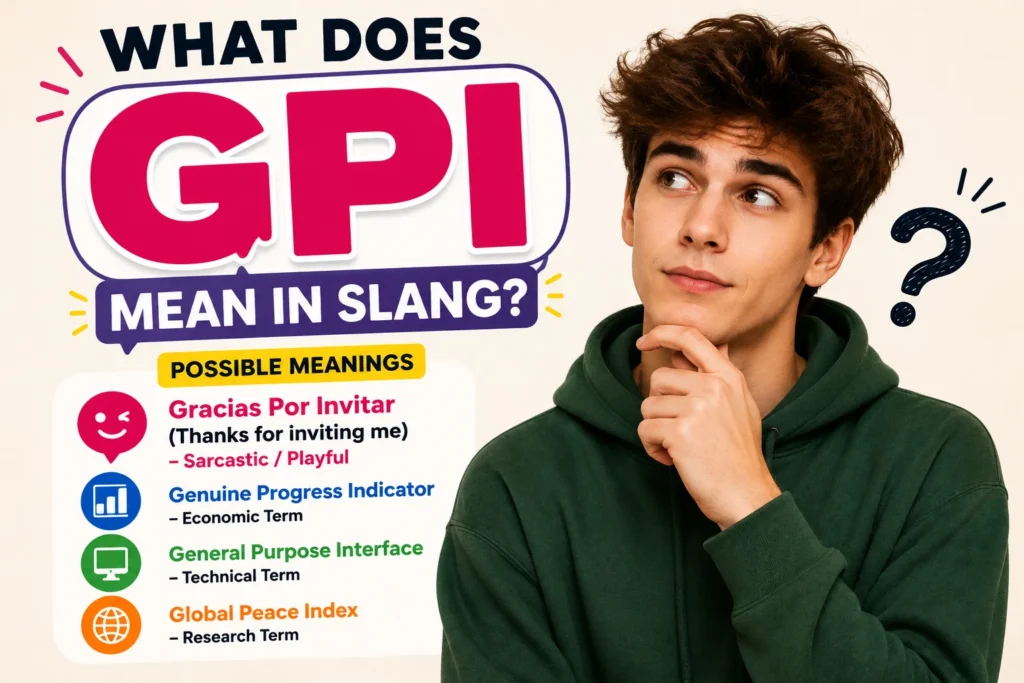
GPI most commonly means “Gracias Por Invitar,” Spanish for “Thanks for inviting me.” In internet slang, it’s usually used sarcastically when someone discovers they weren’t invited to an event, trip, or gathering. Many people search “what does GPI mean slang” because they see it in social media comments without understanding the joke.
What Does GPI Mean in Slang?
Unlike many English texting abbreviations, GPI comes from Spanish internet culture. Although the literal translation is “Thanks for inviting me,” the phrase is rarely sincere. Instead, it’s a humorous or sarcastic way of saying:
- “I can’t believe you didn’t invite me.”
- “Looks like everyone had fun without me.”
- “Thanks for leaving me out.”
It’s especially common when someone posts photos or videos from a party, vacation, concert, or dinner after the event has already happened.
Primary Meaning: Gracias Por Invitar
The most widely recognized slang meaning of GPI is “Gracias Por Invitar.”
Instead of expressing gratitude, the phrase politely hides disappointment or playful frustration.
For example:
- You all went to the beach? GPI 😭
- Saw your birthday photos… GPI 😂
- Movie night without me? GPI.
In each example, the writer is jokingly pointing out that they weren’t invited.
Is GPI Always Sarcastic?
Almost always.
Most social media users understand GPI as light-hearted sarcasm rather than genuine appreciation.
Depending on the relationship, it can communicate:
- playful teasing,
- friendly disappointment,
- mild frustration,
- fear of missing out (FOMO).
Among close friends, it’s usually interpreted as humor rather than criticism.
Other Meanings of GPI
Outside internet slang, GPI has several legitimate acronym meanings, including technical, business, and economic terms.
Some examples include:
- Genuine Progress Indicator
- General Purpose Interface
- Global Peace Index (in some contexts)
These meanings are unrelated to texting slang. When you see GPI in an Instagram comment or WhatsApp chat, “Gracias Por Invitar” is usually the intended meaning.
Is GPI an Acronym, Abbreviation, or Slang?
Technically, GPI is an initialism because each letter represents the first letter of a word.
Online, it also functions as internet slang, since people recognize the abbreviation as a complete emotional reaction rather than spelling out the full phrase.
| Type | Does GPI Fit? | Explanation |
|---|---|---|
| Abbreviation | ✅ Yes | Shortens a longer phrase. |
| Initialism | ✅ Yes | Each letter represents one word. |
| Internet slang | ✅ Yes | Used informally in digital conversations. |
| Acronym | ❌ No | People usually pronounce each letter separately. |
Where Is GPI Used?
Although GPI originated in Spanish-speaking communities, it now appears across several social media platforms wherever bilingual users interact.
TikTok
TikTok is one of the easiest places to find GPI.
Users commonly comment GPI on videos showing:
- vacations,
- birthday parties,
- weddings,
- concerts,
- family gatherings,
- road trips.
Examples:
- GPI 😭
- Next time invite me lol… GPI.
- Everyone had fun except me 😂 GPI.
The abbreviation is often paired with crying or laughing emojis to show that the complaint is playful.
Instagram is arguably where GPI is most recognizable.
After someone uploads vacation photos or group selfies, friends frequently comment:
- GPI 😂
- Qué bonito… GPI.
- La próxima sí invítame. GPI.
Rather than writing a long sentence, GPI instantly communicates “You forgot about me.”
GPI also appears in WhatsApp group chats.
For example:
A: We finally went hiking yesterday!
B: GPI 😭
A: We’ll bring you next time!
Friends often use it jokingly to keep the conversation light.
X (formerly Twitter)
On X, GPI appears in reaction posts when users see pictures from events they missed.
Examples:
- Everyone went except me. GPI.
- Concert looked amazing… GPI 😂
Because X favors short posts, abbreviations like GPI fit naturally.
Snapchat
Public evidence for Snapchat is limited because most conversations are private. However, bilingual users occasionally use GPI in snaps or chat messages after seeing friends spend time together without them.
The meaning remains the same: a playful complaint about not being invited.
Tone and Context Variations
GPI almost always expresses being left out, but the tone depends on the relationship between the people involved.
Playful
A: We grabbed pizza after class.
B: GPI 😂
A: Next time you’re definitely coming.
B: I’ll remember that.
This is the most common use of GPI.
Funny
A: Family vacation photos just dropped.
B: GPI 😭
A: You weren’t even in the country.
B: Details don’t matter.
The humor comes from pretending there was an expectation of being invited.
Sarcastic
A: Thanks for inviting the whole office.
B: 😅
A: Seriously… GPI.
B: I knew you’d say that.
The sarcasm is obvious, but it remains light-hearted.
Mildly Serious
A: I found out everyone met up yesterday.
B: Wait… really?
A: Yeah. GPI.
B: I’d honestly feel disappointed too.
Although GPI is usually humorous, it can sometimes communicate genuine feelings if someone truly feels excluded.
Grammar and Language Role
Part of Speech
GPI usually functions as an interjection or a complete conversational response.
Examples:
- GPI.
- Wow… GPI 😂
- Vacation without me? GPI.
Sentence Position
You’ll most often see GPI:
- At the end of a sentence.
- As a stand-alone reply.
- Following a photo or video of an event.
Examples:
- You all went bowling? GPI.
- GPI 😭
- Looks fun… GPI.
Can It Replace a Full Sentence?
Yes.
Instead of writing:
“Thanks for not inviting me.”
Someone can simply reply:
GPI 😂
The context makes the meaning immediately clear.
Formal vs Informal Register
| Situation | Appropriate? |
|---|---|
| Friends | ✅ Yes |
| Family chats | ✅ Yes |
| Group chats | ✅ Yes |
| Instagram comments | ✅ Very common |
| TikTok comments | ✅ Very common |
| Workplace chat | ⚠️ Only with close coworkers |
| Professional emails | ❌ No |
| Academic writing | ❌ No |
GPI belongs to casual internet communication and should not be used in formal settings.
Real Chat Examples
1. Instagram Comments
A: Best birthday ever! 🎉
B: GPI 😂
A: Haha, next year you’re first on the list.
B: I’ll hold you to that.
2. TikTok
A: Weekend cabin trip with the crew!
B: GPI 😭
A: We thought you were busy.
B: I would’ve canceled my plans.
3. Friends Group Chat
A: Just got back from the beach.
B: Wait… everyone went?
A: Pretty much.
B: GPI.
4. WhatsApp
A: Dinner was amazing tonight.
B: GPI 😂
A: Sorry! It was a last-minute plan.
B: I’m joking… mostly.
5. X (Twitter)
A: Concert photos are finally up!
B: GPI.
A: Next tour, you’re coming.
B: I’m saving that promise.
6. Family Group Chat
A: We all went out for ice cream after dinner.
B: GPI 😭
A: You were at work.
B: That’s not the point.
7. College Friends
A: We watched the game together last night.
B: GPI.
A: We thought you were studying.
B: I would’ve taken a study break.
8. Coworkers
A: Team lunch was great today.
B: GPI 😂
A: It was a last-minute thing.
B: That’s what everyone says.
9. Cousins
A: Just posted photos from the family barbecue.
B: GPI.
A: You live three states away.
B: Excuses, excuses.
10. Gaming Friends
A: We finally beat the raid.
B: GPI 😭
A: You were offline.
B: I would’ve logged in if I’d known.
How to Reply to GPI
Since GPI usually means someone is jokingly complaining about being left out, your response should acknowledge the joke while keeping the conversation friendly.
Funny Reply
- “Invitation got lost in the mail.”
- “We’ll send the VIP pass next time.”
- “The committee forgot your application.”
- “You were there in spirit.”
Serious Reply
- “Sorry, we honestly thought you were busy.”
- “We’ll make sure you’re included next time.”
- “That’s fair. We should’ve told you.”
- “I understand why you’d feel left out.”
Neutral Reply
- “Maybe next time.”
- “We’ll plan something soon.”
- “Good point.”
- “Noted.”
Flirty Reply
Because GPI revolves around invitations and social plans, a light flirty response can work if the relationship already has that tone.
- “Fine, next outing is just you and me.”
- “I’ll make sure you’re my first invite.”
- “Guess I’ll have to take you out separately.”
- “You’re on the VIP guest list now.”
GPI vs Similar Slang Terms
| Term | Meaning | Usage Context | Tone | Popularity | Confusion Risk |
|---|---|---|---|---|---|
| GPI | Gracias Por Invitar | Being left out of an event | Playful, sarcastic | High in Spanish-speaking communities | Medium |
| FOMO | Fear Of Missing Out | Missing experiences | Serious or playful | Very High | Low |
| SMH | Shaking My Head | Disappointment | Negative | Very High | Low |
| LOL | Laughing Out Loud | Humor | Positive | Extremely High | Very Low |
| IDC | I Don’t Care | Indifference | Neutral | High | Low |
| INV? | Invitation? | Asking why you weren’t invited | Playful | Lower | Medium |
Key Insight
The closest concept to GPI is FOMO. However, FOMO describes the feeling of missing out, while GPI is a direct, often sarcastic response aimed at the people who didn’t include you.
Who Uses GPI?
Age Group Breakdown
Gen Z
Gen Z users are the most likely to use GPI regularly.
The term appears frequently in:
- TikTok comments
- Instagram posts
- WhatsApp chats
- group conversations
Many younger users view it as a quick reaction rather than a literal phrase.
Millennials
Millennials often recognize GPI but are less likely to use it daily.
Many prefer writing:
- “Thanks for inviting me.”
- “Looks like I missed out.”
- “Guess I wasn’t invited.”
instead of using the abbreviation.
Regional Usage
GPI is strongest in:
- Mexico
- Spain
- Colombia
- Argentina
- other Spanish-speaking communities
The slang has spread globally through bilingual social media users, but it remains far less common among English-only audiences.
There is no reliable evidence that GPI originated in English-speaking internet culture.
Platform Summary
| Platform | Usage Level |
|---|---|
| Very Common | |
| TikTok | Very Common |
| Common | |
| X (Twitter) | Common |
| Snapchat | Occasional |
Origin and Internet Culture
Where Did GPI Come From?
GPI originated from the Spanish phrase:
“Gracias Por Invitar.”
Literally translated, it means:
“Thanks for inviting me.”
The phrase became popular because of its sarcasm.
Instead of directly saying:
“Why wasn’t I invited?”
users could write:
“GPI.”
The abbreviation sounds polite on the surface while clearly communicating the opposite message.
How It Spread Online
Social media played a major role in the growth of GPI.
Users began commenting GPI under:
- vacation photos,
- birthday celebrations,
- concerts,
- weddings,
- parties,
- group selfies.
Because the abbreviation is short and easy to recognize, it became a standard reaction in Spanish-language comment sections.
Connection to Meme Culture
GPI fits naturally into meme culture because it combines:
- humor,
- sarcasm,
- relatability,
- social exclusion jokes.
Many users don’t actually feel offended when using GPI. Instead, they’re participating in a shared internet joke about being left out.
Evolution of the Meaning
The phrase itself hasn’t changed much.
Unlike many slang terms that develop multiple meanings over time, GPI remains closely tied to its original purpose:
playfully calling attention to not being invited.
Safety and Appropriateness
Is GPI Offensive?
No.
GPI is generally considered harmless slang.
Does It Contain Profanity?
No.
There is no profanity, explicit language, or offensive content in the abbreviation.
School and Workplace Appropriateness
Appropriate for:
- friends
- family
- social media
- casual chats
- group messages
Not ideal for:
- professional emails
- formal business communication
- academic writing
Cultural Considerations
Because GPI comes directly from Spanish-language internet culture, it’s helpful to understand the phrase before using it.
Most native Spanish speakers recognize the sarcastic intent immediately.
People unfamiliar with Spanish may not understand the abbreviation at all.
Real-World Observation
What makes GPI interesting is that it allows people to express exclusion without creating conflict. Instead of directly confronting friends with “Why didn’t you invite me?”, users can simply comment “GPI” and let humor do the work. In practice, most GPI comments aren’t serious complaints. They’re social signals that say, “I would’ve liked to be there too.” That balance between humor and mild disappointment is one reason the abbreviation has remained popular across Spanish-speaking social media for years.
Frequently Asked Questions
What does GPI mean in texting?
In texting, GPI usually means “Gracias Por Invitar” or “Thanks for inviting me.” However, the phrase is normally sarcastic rather than sincere. People use it when they discover they were left out of an event or gathering.
What does GPI mean on Instagram?
On Instagram, GPI is commonly posted under vacation photos, birthday pictures, party uploads, and group selfies. The commenter is jokingly pointing out that they weren’t invited. It’s one of the most common places where the abbreviation appears.
Is GPI rude?
Not usually. Most people use GPI humorously and don’t intend to start an argument. However, the tone can feel passive-aggressive if used repeatedly or in situations where someone genuinely feels excluded.
Is GPI Spanish slang?
Yes. GPI comes from the Spanish phrase “Gracias Por Invitar.” While it has spread through international social media, its roots are firmly connected to Spanish-speaking online communities.
What is the English equivalent of GPI?
There isn’t a perfect English abbreviation with the same meaning. The closest translation would be sarcastically saying, “Thanks for inviting me.” Some people also compare the feeling behind GPI to FOMO, though the meanings aren’t identical.
Can GPI be used seriously?
Yes, but that is less common. Most uses are playful or sarcastic. In certain situations, however, someone may use GPI to express genuine disappointment about being excluded.
Why is GPI popular on social media?
GPI is short, recognizable, and relatable. Nearly everyone has experienced being left out at some point. The abbreviation turns that experience into a quick joke that works across comments, captions, and private messages.
Does GPI have other meanings?
Yes. Outside slang, GPI can refer to many professional, economic, and technical terms. However, in social media conversations, the slang meaning “Gracias Por Invitar” is usually the intended interpretation.
Conclusion
GPI most commonly means “Gracias Por Invitar” or “Thanks for inviting me.” Despite sounding polite, it’s usually used sarcastically when someone realizes they weren’t included in a trip, party, dinner, or other social activity. The abbreviation has become especially popular across Instagram, TikTok, WhatsApp, and X among Spanish-speaking and bilingual users.
Usage Tips
- Use GPI when jokingly pointing out that you weren’t invited.
- Add emojis to make the playful tone clear.
- Use it with friends and informal social media conversations.
- Consider whether the other person understands Spanish-language slang.
Common Mistakes
- Assuming GPI expresses genuine gratitude.
- Using it in professional communication.
- Misinterpreting it as anger rather than sarcasm.
- Expecting all English speakers to recognize the abbreviation.
When to Use / When to Avoid
Use: Social media comments, group chats, texting friends, and casual online conversations.
Avoid: Formal writing, workplace communication, academic settings, or situations where the joke could be misunderstood as a serious complaint.