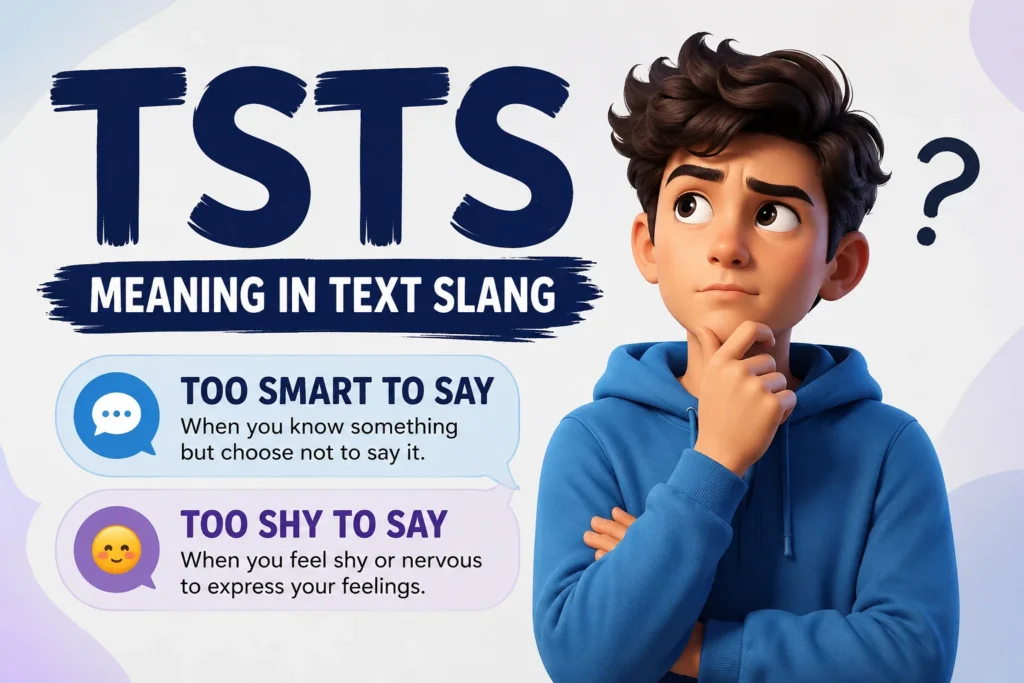
TSTS meaning in text slang is most commonly interpreted as “Too Smart To Say” or, in some online communities, “Too Shy To Say.” Because TSTS isn’t a standardized internet acronym, many people search its meaning after seeing it in a text, TikTok comment, Snapchat message, or private chat where the context isn’t obvious.
What Does TSTS Mean in Text Slang?
Unlike abbreviations such as “LOL” or “IDK,” TSTS is a context-dependent internet abbreviation rather than a universally accepted slang term. The meaning depends on where you see it and who is using it.
The two meanings you’ll encounter most often are:
Too Smart To Say (Most Common)
The most frequently intended meaning is “Too Smart To Say.”
People use it to suggest they already know something but intentionally choose not to say it aloud. It often carries a playful, sarcastic, or teasing tone.
Example:
A: So who started the drama?
B: TSTS 😏
Here, the sender implies they know the answer but won’t reveal it.
Too Shy To Say
A smaller number of users use TSTS to mean “Too Shy To Say.”
This version appears in casual conversations when someone feels embarrassed or nervous about expressing a thought or feeling.
Example:
A: Why didn’t you tell them you liked them?
B: TSTS 😂
In this case, the abbreviation expresses hesitation rather than secrecy.
Is TSTS an Acronym or Slang?
TSTS is:
- Type: Acronym
- Category: Internet slang abbreviation
- Primary use: Casual texting and social media
- Formality: Informal only
Unlike established slang terms, TSTS doesn’t have one official dictionary definition, so readers usually rely on conversation context.
Where Is TSTS Used?
TSTS appears only occasionally compared with mainstream texting abbreviations. Its usage varies by platform.
TikTok
On TikTok, TSTS sometimes appears in comment sections where users hint at inside jokes, drama, or hidden opinions without explaining further.
Example:
“I know exactly what happened… TSTS 😂”
Instagram users occasionally include TSTS in comment threads or story replies, especially when reacting to gossip or humorous situations.
Example:
“Girl… TSTS 😭”
Snapchat
Snapchat conversations are one of the more common places to see TSTS because chats are casual and filled with private jokes.
Example:
“You already know why lol. TSTS.”
Friends sometimes use TSTS in group chats when everyone already understands the situation.
Example:
“No explanation needed… TSTS.”
X (formerly Twitter)
TSTS is relatively uncommon on X. When it does appear, it’s usually in replies where someone hints at information without sharing details publicly.
TSTS Tone Variations
The same abbreviation can communicate different emotions depending on context.
Funny
A: Who ate the last slice of pizza?
B: TSTS 😂
A: You’re definitely guilty.
B: You’ll never prove it.
Sarcastic
A: Was your meeting actually productive?
B: TSTS.
A: So… not really?
B: Exactly.
Playful
A: Who’s your favorite person here?
B: TSTS 😏
A: You’re avoiding the question.
B: That’s part of the fun.
Serious
A: Is there something you’re not telling me?
B: TSTS.
A: Okay, I won’t push.
B: Thanks for understanding.
11 Real Chat Examples
1. Friends (Snapchat)
A: Did you hear what happened?
B: Yep.
A: Tell me!
B: TSTS 😂
2. School Friends
A: Who failed the surprise quiz?
B: TSTS.
A: You’re protecting someone.
B: Maybe.
3. Family Group Chat
A: Who forgot Grandma’s birthday?
B: TSTS.
A: I already know.
B: Then we don’t need names.
4. Gaming Chat
A: Who caused the team wipe?
B: TSTS 😅
A: It was you.
B: No comment.
5. Workplace Friends
A: Who keeps taking everyone’s snacks?
B: TSTS.
A: Office mystery continues.
B: Exactly.
6. Instagram DMs
A: Who were you talking about?
B: TSTS.
A: You’re impossible.
B: That’s fair.
7. Relationship Chat
A: Do you still like them?
B: TSTS.
A: I’ll take that as yes.
B: Interpret it however you want.
8. WhatsApp Group
A: Who’s always late?
B: TSTS 😂
A: We all know anyway.
B: Exactly.
9. College Friends
A: Who got the highest grade?
B: TSTS.
A: It was definitely you.
B: I’m staying quiet.
10. Online Community
A: Is the rumor true?
B: TSTS.
A: Interesting answer.
B: That’s all I’ll say.
11. Weekend Plans
A: So who canceled last minute?
B: TSTS.
A: Someone’s being diplomatic.
B: Always.
Grammar and Language Role
Part of Speech
TSTS functions as an initialism used as a complete discourse marker rather than a traditional grammatical part of speech.
Sentence Position
It usually appears:
- As a standalone reply
- At the end of a sentence
- Occasionally after an emoji
Examples:
TSTS.
I know the answer… TSTS.
Can It Replace a Full Sentence?
Yes.
Instead of writing:
“I know, but I’m not going to tell you.”
Someone may simply reply:
TSTS.
Formal vs Informal
TSTS belongs entirely to informal digital communication.
It should not be used in:
- professional emails
- academic writing
- business reports
- customer communication
How to Reply to TSTS
Funny Reply
“Keeping secrets again? 😂”
Serious Reply
“That’s okay. You don’t have to share if you don’t want to.”
Flirty Reply
If the conversation is already flirtatious:
“Now you’ve made me even more curious 😉”
Neutral Reply
“Fair enough.”
TSTS Compared With Similar Terms
| Term | Meaning | Usage Context | Tone | Popularity | Confusion Risk |
|---|---|---|---|---|---|
| TSTS | Too Smart To Say / Too Shy To Say | Text conversations | Playful, secretive | Low | High |
| IDC | I Don’t Care | Casual texting | Neutral | Very High | Low |
| NVM | Never Mind | Ending a topic | Neutral | Very High | Low |
| TBH | To Be Honest | Honest opinions | Friendly | Very High | Low |
| IDK | I Don’t Know | Answering questions | Neutral | Extremely High | Very Low |
| FYI | For Your Information | Sharing information | Informative | High | Very Low |
Who Uses TSTS?
Age Groups
Teenagers (13–19)
The abbreviation appears most often among teenagers who enjoy niche internet abbreviations and inside jokes.
Young Adults (20–30)
Young adults occasionally use it in private chats, though many prefer clearer abbreviations.
Gen Z vs Millennials
Gen Z
- More likely to understand context-based abbreviations.
- Often pairs TSTS with emojis or memes.
- Uses it ironically.
Millennials
- Less likely to use TSTS regularly.
- More likely to ask what it means if encountered unexpectedly.
Regional Usage
There is no reliable evidence that TSTS belongs to one specific English-speaking country. It appears sporadically across online communities in the US, UK, Canada, Australia, and other English-speaking regions where internet slang is shared.
Platforms
Most sightings occur in:
- Snapchat
- Instagram DMs
- TikTok comments (occasionally)
It is uncommon on public platforms compared with mainstream abbreviations.
Origin and Internet Culture
Unlike famous abbreviations such as LOL or BRB, TSTS has no well-documented origin. It appears to have emerged organically in private online conversations where users created shorthand expressions for recurring phrases.
There is no verified connection to AAVE, and no evidence that it originated from a specific cultural movement or community.
Its limited popularity has prevented it from becoming a standardized internet acronym. Instead, it survives as a niche expression that people interpret through context.
On social media, TSTS often appears alongside:
- teasing replies
- reaction memes
- gossip discussions
- inside jokes
- humorous comment threads
Its appeal comes from suggesting there’s more to the story without actually revealing it.
Is TSTS Rude or Offensive?
Generally, no.
TSTS is not considered profanity or offensive language.
However, it can occasionally seem dismissive if someone genuinely wants an answer and receives only “TSTS.”
Workplace
Avoid using it in professional communication because many coworkers won’t recognize it.
School
It is generally appropriate among friends but may confuse teachers or classmates unfamiliar with the abbreviation.
Cultural Sensitivity
There are no known cultural or offensive associations connected to TSTS.
Real-World Observation
In everyday digital conversations, TSTS works less as a fixed dictionary term and more as a conversational shortcut. People usually use it to create curiosity, protect someone’s privacy, or keep a joke going without spelling everything out. That flexibility is also why it causes confusion—unless both people share the same context, the abbreviation can be interpreted differently. Its continued, if limited, use reflects a broader internet habit of inventing short, playful expressions that make private conversations feel more personal.
Frequently Asked Questions
What does TSTS mean in text slang?
Most commonly, TSTS means “Too Smart To Say.” In some conversations, it can also mean “Too Shy To Say.” Because it isn’t a standardized abbreviation, the surrounding conversation determines which meaning fits best.
Is TSTS a popular texting abbreviation?
Not really. TSTS is considered a niche acronym rather than a mainstream texting abbreviation. Many internet users have never encountered it, which is why they often search for its meaning after seeing it in a conversation.
What does TSTS mean on Snapchat?
On Snapchat, TSTS usually means someone knows the answer but doesn’t want to reveal it. It is commonly used among friends during casual conversations, jokes, or discussions about gossip.
What does TSTS mean on TikTok?
When used on TikTok, TSTS generally suggests hidden knowledge or an inside joke in the comments. It is much less common than abbreviations such as POV, FYP, or IYKYK, but it occasionally appears in replies where users avoid explaining something directly.
Is TSTS rude?
Not by itself. The abbreviation is generally playful or teasing, but if someone expects a direct answer, replying only with “TSTS” may come across as evasive or slightly dismissive. The relationship between the speakers usually determines how it is received.
Can TSTS have more than one meaning?
Yes. The two meanings most often seen online are “Too Smart To Say” and “Too Shy To Say.” Since neither meaning is officially standardized, readers should always look at the surrounding messages before deciding which interpretation is correct.
Should I use TSTS in professional messages?
It’s best not to. Because TSTS is uncommon and context-dependent, colleagues or clients may not understand it. Clear, complete language is a better choice for workplace communication.
Why do people search for TSTS meaning?
People usually search for it after receiving a text or spotting it in a comment without enough context to understand it. Since TSTS lacks a single universally accepted definition, online searches help clarify which meaning is most likely in a particular conversation.
What does TSTS stand for in texting?
In texting, TSTS most commonly stands for “Too Smart To Say.” People use it when they know the answer to something but intentionally choose not to reveal it. In some conversations, it can also mean “Too Shy To Say,” although that interpretation is less common. Since TSTS isn’t a standardized acronym, the surrounding conversation is the best way to determine its meaning.
What does TSTS mean on Snapchat?
On Snapchat, TSTS is usually used during casual conversations between friends. It often suggests that the sender knows something but prefers to keep it private or let the other person figure it out. You’ll often see it alongside emojis like 😏, 😂, or 🤐 to reinforce a playful or mysterious tone.
Is TSTS a real slang word?
TSTS is a real internet acronym, but it isn’t considered mainstream slang like LOL, BRB, or TBH. Its usage is relatively niche and tends to appear in private chats or smaller online communities rather than across all social media platforms. Because it’s uncommon, many people search for its meaning after encountering it for the first time.
Can TSTS have more than one meaning?
Yes. The two most recognized meanings are “Too Smart To Say” and “Too Shy To Say.” Since neither definition is officially standardized, users rely on context to interpret the intended meaning. If the conversation doesn’t provide enough clues, it’s perfectly reasonable to ask the sender for clarification.
Should I use TSTS in professional conversations?
No. TSTS is best reserved for informal conversations with friends or people who are familiar with internet abbreviations. Using it in emails, business messages, or academic settings may confuse readers because it isn’t widely recognized. In professional communication, writing out your intended message is usually the better choice.
Why is TSTS difficult to understand?
Unlike popular abbreviations that have one universally accepted definition, TSTS doesn’t have a single official meaning. Different online communities may use it differently, and some people may never have seen it before. That’s why understanding the surrounding conversation is essential before assuming what the acronym means.
Is TSTS popular on TikTok and Instagram?
TSTS appears occasionally on TikTok and Instagram, especially in comment sections, DMs, or replies involving inside jokes or gossip. However, it isn’t among the platform’s most commonly used abbreviations. Acronyms like POV, FYP, IYKYK, and TBH are still much more widespread.
How should I respond when someone sends TSTS?
Your reply depends on the conversation. If the tone is playful, you can respond with something like, “Now I’m even more curious!” If it’s a serious discussion, you could simply reply, “No worries—I understand.” Matching the sender’s tone is the best way to keep the conversation natural.
Conclusion
TSTS is a niche internet acronym that most often means “Too Smart To Say,” while some users interpret it as “Too Shy To Say.” Because it isn’t a standardized slang term, context is the key to understanding it correctly. You’ll mainly see it in private chats, social media comments, and conversations where someone wants to hint at something without saying it directly.
Usage Tips
- Use it only in casual conversations with people who understand internet slang.
- Read the surrounding messages before deciding what it means.
- Treat it as a playful or secretive response rather than a factual statement.
- If there’s any doubt, ask the sender what they meant.
Common Mistakes
- Assuming TSTS always has one fixed definition.
- Using it in professional or academic communication.
- Expecting everyone to recognize the abbreviation.
- Ignoring the conversation context when interpreting it.
When to Use It
- Casual chats with friends.
- Private messages and group chats.
- Playful conversations involving inside jokes or teasing.
When to Avoid It
- Business communication.
- School assignments.
- Formal emails.
- Situations where clarity is more important than brevity.