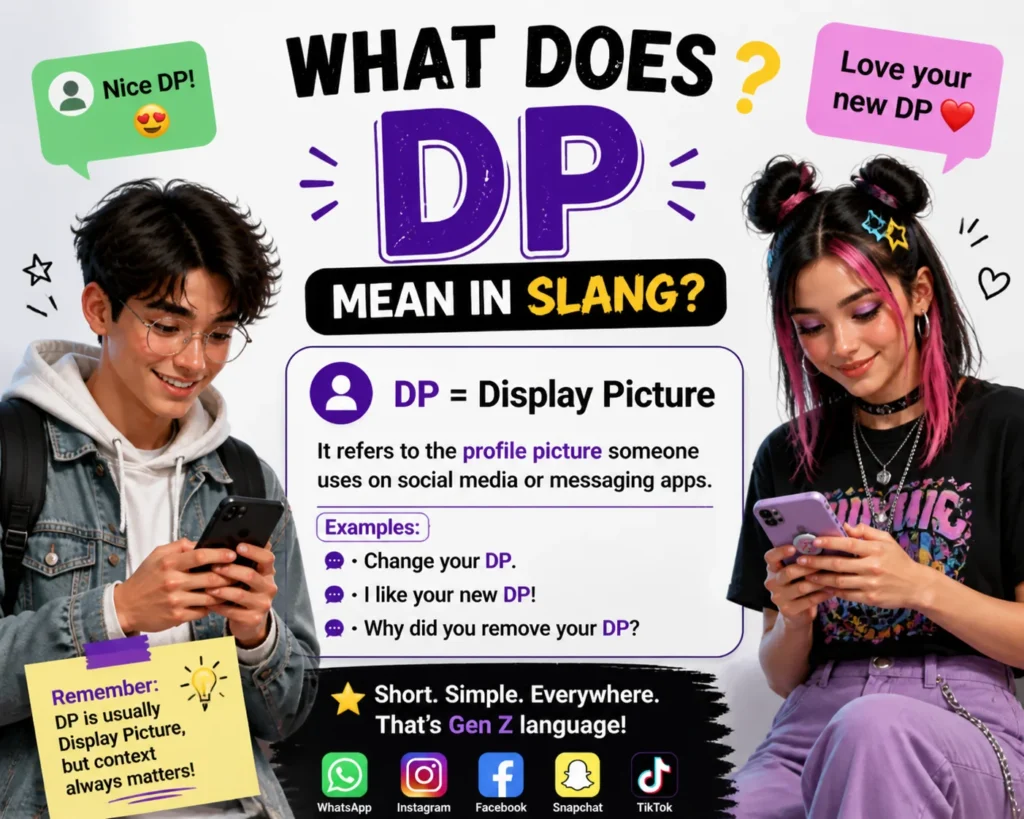
DP in slang usually means “display picture,” which is the profile photo someone uses on WhatsApp, Instagram, Facebook, TikTok, or other social platforms. In some contexts, DP can also have adult or technical meanings, so the exact meaning depends on where and how it is used.
What does DP mean in slang? Most of the time, DP means display picture. It refers to the image shown on someone’s social media profile or messaging account. For example, “Nice DP” means “Nice profile picture.” However, because DP can mean different things in different spaces, context matters.
People search for what does dp mean in slang because they often see it in chats, comments, or DMs and are unsure whether it is casual, romantic, rude, or inappropriate.
That confusion is understandable. Slang changes quickly, and short forms often carry more than one meaning. One person may use DP innocently for a profile picture, while another may use it in a completely different context.
This guide explains the meaning clearly, shows real examples, and helps you understand when DP is safe, casual, professional, or better avoided.
What Does DP Mean in Slang – Quick Meaning
In everyday texting and social media slang, DP means “display picture.”
It is another way of saying:
- Profile picture
- Profile photo
- Account photo
- Display image
- Social media picture
When someone says “Change your DP,” they usually mean, “Change your profile picture.”
When someone says “Nice DP,” they are complimenting your photo.
Here are a few simple examples:
“Your DP looks so good!”
“Why did you remove your DP?”
“Put a better DP for your profile.”
In most casual conversations, DP is harmless and very common. It is especially popular in WhatsApp-heavy cultures, where people often notice when someone changes, removes, or updates their profile photo.
Still, context is important. If DP appears in an adult conversation, gaming forum, workplace document, or film production setting, it may mean something else.
Origin & Background
The term DP became popular when messaging apps and social networking sites started using profile photos as part of online identity.
Before smartphones became common, people usually said “profile picture” or “profile photo.” As texting became faster, users shortened the phrase to DP, meaning display picture.
The word “display” refers to what is shown publicly or semi-publicly on a profile. Your DP is the picture people see before they message you, follow you, or visit your account.
WhatsApp played a major role in making this term common, especially in South Asian countries like Pakistan, India, Bangladesh, and Sri Lanka. People often say “DP” more naturally than “profile picture” in everyday chat.
Instagram, Facebook, TikTok, and Snapchat also shaped the meaning. As online photos became linked with mood, confidence, style, beauty, and identity, DP became more than just a picture.
It became a small emotional signal.
A black DP may suggest sadness. A couple DP may show a relationship. A professional DP may show maturity. A funny DP may show personality.
Over time, the meaning evolved from a simple profile image into a social clue. Today, people may read someone’s DP the same way they read a facial expression in real life.
Real-Life Conversations
Person A:
Why did you remove your DP? Everything okay?
Person B:
Yeah, I’m fine. Just wanted a little privacy for a few days.
Person A:
Okay, just checking. I thought maybe something happened.
Person B:
That’s sweet. Don’t worry, I’m okay.
Instagram DMs
Person A:
Your new DP is actually so pretty.
Person B:
Thank you! I was nervous about posting it.
Person A:
No, it suits you. The lighting and smile look natural.
Person B:
That made my day, honestly.
TikTok Comments
Person A:
Not me checking your DP after watching this video.
Person B:
Haha, why?
Person A:
Because your energy in the video is too good. The DP matches the vibe.
Person B:
Best comment today.
Text Messages
Person A:
Bro, use a proper DP for your job account.
Person B:
Is this one bad?
Person A:
Not bad, but too casual. Use one with a clean background.
Person B:
Good point. I’ll change it before sending applications.
Emotional & Psychological Meaning
DP may look like a small slang word, but emotionally, it says a lot about modern communication.
A display picture is often the first impression someone gives online. Before people read your message, they may notice your face, pose, style, or mood.
That is why people care about DPs.
A new DP can express confidence. A removed DP can suggest privacy. A sad quote as a DP may signal emotional pain. A smiling photo may show openness.
People also use DP to start conversations. Instead of saying, “I miss talking to you,” someone may say, “Nice DP.” It feels safer, lighter, and less vulnerable.
In modern communication, indirect messages are common. A person may not openly say they are hurt, lonely, proud, or changing. Instead, they show it through their DP, status, captions, or online presence.
A personal-style scenario makes this clearer.
Imagine someone who has just gone through a difficult week. They do not want to explain everything. They simply remove their DP from WhatsApp. Soon, close friends notice and ask, “Are you okay?” In that moment, the DP becomes more than a picture. It becomes a quiet emotional signal.
That is why understanding what does DP mean in slang also means understanding how people express themselves online.
Usage in Different Contexts
Social Media
On social media, DP usually means profile picture. People use it when talking about someone’s account image.
Examples:
“Your DP is giving main character energy.”
“Change your DP; this one is blurry.”
“Her DP and bio match perfectly.”
On Instagram and TikTok, people may also use “pfp” instead of DP. Both can mean profile picture, but DP is more common in WhatsApp-style conversations.
Friends & Relationships
Among friends, DP is often used casually.
Someone may compliment your DP, tease you about it, or ask why you changed it.
In relationships, DP can carry emotional meaning. A couple DP may show commitment. Removing a shared DP may cause questions. Changing to a sad DP may make someone worry.
Examples:
“You removed our DP?”
“Your DP looks cute.”
“Why are you using that old photo?”
Tone matters here. A simple DP comment can feel caring, romantic, jealous, or playful depending on the relationship.
Work / Professional Settings
In professional settings, it is better to say profile photo instead of DP.
For example, instead of writing:
“Please update your DP.”
Say:
“Please update your profile photo.”
DP is casual and may not sound polished in formal emails, HR documents, LinkedIn guidance, or business communication.
However, in casual workplace chats, especially among younger teams, DP may still be understood.
Casual vs Serious Tone
DP is casual when used among friends.
It can be serious when linked to privacy, identity, branding, or professionalism.
For example:
“Nice DP” sounds casual.
“Your company DP should follow brand guidelines” sounds more professional, but “profile image” would still be better.
The meaning stays similar, but the tone changes with context.
When NOT to Use It
Do not use DP when the setting requires formal language.
Avoid it in:
- Professional emails
- Academic writing
- Legal documents
- Official reports
- Sensitive conversations
- Conversations with people unfamiliar with slang
You should also be careful because DP can have adult meanings in some contexts. If the conversation is not clearly about social media or profile pictures, the abbreviation may be misunderstood.
Cultural sensitivity matters too. In some communities, commenting on someone’s photo can feel personal, flirtatious, or intrusive.
For example, saying “Nice DP” to a close friend is normal. Saying it to a senior colleague, teacher, or someone you barely know may feel too personal.
Also avoid using DP jokes when someone has removed their profile picture during a difficult time. They may be dealing with stress, grief, privacy concerns, or personal conflict.
Common Misunderstandings
One common misunderstanding is thinking DP always means display picture.
It does not.
In most social media and texting situations, it does. But in adult spaces, DP can mean something explicit. In film, DP can mean director of photography. In business or tech, it may mean data processing or another technical phrase.
Another misunderstanding is tone.
If someone says “Nice DP,” they may simply be complimenting your profile photo. But depending on the relationship, it may also sound flirty.
People also confuse DP with PFP. Both can refer to a profile image, but PFP is more common in gaming, TikTok, Discord, and global internet slang. DP is more common in WhatsApp, Facebook, and South Asian digital culture.
Literal vs figurative meaning can also confuse people.
Literally, DP means the picture displayed on your profile. Figuratively, people may use it to comment on your mood, personality, or online image.
For example, “Your DP looks sad” does not only describe the image. It may also suggest, “You seem emotionally low.”
Comparison Table
| Term | Meaning | Similar or Opposite | Common Use |
|---|---|---|---|
| DP | Display picture | Main slang term | WhatsApp, Facebook, Instagram |
| PFP | Profile picture | Similar slang | TikTok, Discord, gaming |
| Avatar | Digital identity image | Related expression | Gaming, forums, apps |
| Profile photo | Formal version of DP | Similar meaning | Work, LinkedIn, official accounts |
| Icon | Small account image | Related expression | Apps, forums, design |
| Header photo | Cover image, not DP | Related but different | X, Facebook, LinkedIn |
| Bio | Profile text, not image | Related profile term | Instagram, TikTok |
| No DP | No profile picture | Opposite state | Privacy or blank profile |
| Selfie | Self-taken photo | Can be used as DP | Casual social media |
| Display name | Name shown on profile | Related identity term | Messaging apps |
Key Insight:
DP is not just a shortcut for “display picture.” In real conversations, it often points to identity, mood, confidence, privacy, and how people want to be seen online.
Variations / Types
1. New DP
A recently changed display picture.
People say this when someone updates their profile photo.
2. Cute DP
A profile picture that looks sweet, attractive, or charming.
It is often used as a compliment.
3. Sad DP
A display picture that shows sadness, loneliness, or emotional pain.
It may be a dark image, quote, or serious photo.
4. Black DP
A black or blank profile picture.
It can suggest privacy, sadness, protest, or simply a style choice.
5. Couple DP
A display picture featuring two people in a relationship.
It often shows affection or commitment.
6. Family DP
A profile picture with family members.
It is common among parents, relatives, and family-focused users.
7. Professional DP
A clean, formal profile photo.
It is useful for LinkedIn, job accounts, and business profiles.
8. Funny DP
A humorous or meme-style profile picture.
It shows a playful personality.
9. Aesthetic DP
A stylish, visually pleasing profile image.
It may include soft colors, filters, nature, or artistic poses.
10. Hidden DP
A profile picture visible only to selected contacts.
This is common on WhatsApp privacy settings.
How to Respond When Someone Uses It
Casual Replies
“Thank you, I just changed it.”
“Really? I wasn’t sure about this one.”
“Thanks, I liked the lighting.”
“Yeah, this photo felt more natural.”
Funny Replies
“Finally, my DP got the attention it deserves.”
“New DP, same old me.”
“I spent 20 minutes choosing it, so thanks.”
“My DP has better confidence than me.”
Mature Replies
“Thank you, I wanted something more professional.”
“I appreciate that. I was trying a cleaner look.”
“Thanks, I felt it represented me better.”
“That means a lot. I usually overthink profile pictures.”
Respectful Replies
“Thank you, that’s kind of you.”
“I appreciate the compliment.”
“Thanks, I’m glad it looks okay.”
“That’s nice of you to say.”
If someone asks why you removed your DP, you can respond gently:
“I just wanted some privacy.”
“Nothing serious, just taking a break.”
“I changed my settings for a while.”
Regional & Cultural Usage
Western Culture
In Western countries, people often say profile picture or PFP more than DP.
DP may still be understood, but it is not always the first slang term people use. On platforms like Discord, TikTok, Reddit, and gaming communities, PFP is more common.
Asian Culture
In many Asian countries, especially South Asia, DP is very common.
People regularly say “Change your DP,” “Nice DP,” or “Why no DP?” in WhatsApp and Facebook conversations.
In some cultures, a DP can also carry social meaning. A family DP may show respectability. A professional DP may show seriousness. A removed DP may trigger concern.
Middle Eastern Culture
In Middle Eastern digital culture, profile pictures can be more private, especially depending on family, gender norms, and personal boundaries.
Some users avoid showing their face publicly. Others use flowers, quotes, landscapes, children, family images, or religious symbols.
So, commenting on someone’s DP should be done respectfully. What feels casual in one culture may feel too personal in another.
Global Internet Usage
Globally, DP, PFP, avatar, and profile photo are all connected.
The preferred term depends on the platform. WhatsApp users often say DP. Discord and TikTok users often say PFP. Professional users usually say profile photo.
The meaning is similar, but the social setting changes the best word choice.
Generational Differences
Gen Z often uses PFP, avatar, icon, or profile pic, especially on TikTok, Discord, and gaming platforms.
Millennials are more likely to use DP, especially if they grew up with Facebook, BBM, WhatsApp, and early smartphone messaging.
Older users may simply say “photo” or “profile picture.”
This difference can create small misunderstandings, but the idea is usually easy to understand once the context is clear.
Is It Safe for Kids?
DP is generally safe for kids when it means display picture or profile picture.
However, parents and teachers should know that DP can have adult meanings in some online spaces. For children, it is better to teach the safe meaning while also explaining that abbreviations can change depending on context.
Kids should also understand privacy. A DP can reveal their face, school uniform, location, family, or personal life. So, choosing a safe profile picture matters.
FAQs
What does DP mean in slang?
DP usually means display picture in slang. It refers to the profile photo someone uses on messaging apps or social media.
What does DP mean on WhatsApp?
On WhatsApp, DP means your profile picture. It is the image your contacts see beside your name or chat.
What does “nice DP” mean?
“Nice DP” means someone likes your profile picture. It is usually a casual compliment.
Is DP the same as profile picture?
Yes, in most social media contexts, DP and profile picture mean the same thing.
What does DP mean on Instagram?
On Instagram, DP can mean profile picture, though many users also say PFP or profile photo.
Can DP have another meaning?
Yes. DP can have adult, technical, or professional meanings depending on context. In everyday texting, it most often means display picture.
Is DP a bad word?
No, DP is not bad when it means display picture. But because it can have adult meanings elsewhere, context is important.
What is the difference between DP and PFP?
DP means display picture, while PFP means profile picture. Both usually refer to the same thing.
Why do people remove their DP?
People may remove their DP for privacy, emotional reasons, personal space, or simply because they want a change.
Should I use DP in professional messages?
It is better to use “profile photo” in professional messages. DP sounds casual and may not suit formal communication.
Conclusion
Now you know the answer to what does dp mean in slang: in most everyday conversations, DP means display picture, or the profile photo someone uses online.
It may seem like a small abbreviation, but it carries real social meaning. A DP can show confidence, privacy, mood, personality, professionalism, or emotional change.
The safest way to understand DP is to read the context. If the conversation is about WhatsApp, Instagram, Facebook, or someone’s profile, it almost certainly means display picture.
Use it casually with friends, carefully with new people, and avoid it in formal writing when “profile photo” sounds clearer.
A good DP is more than a picture. It is often the first small window into how someone wants to be seen.