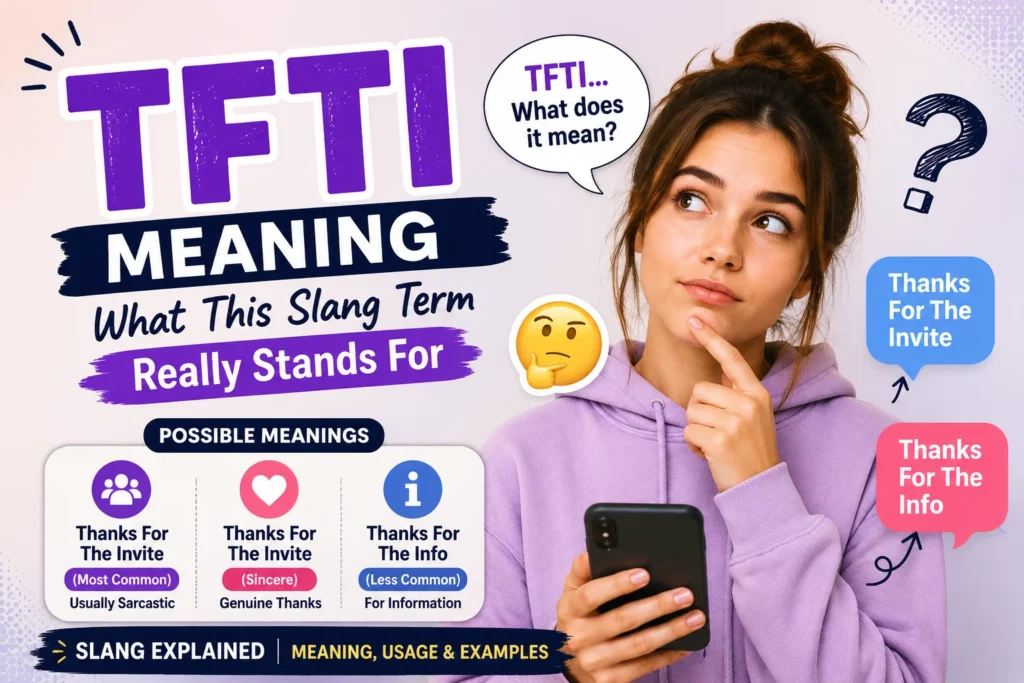
TFTI stands for “Thanks For The Invite.” It’s almost always used sarcastically — someone posts photos or a story from an event, and a person who wasn’t invited comments “TFTI” to call it out publicly, half-joking and half-genuinely annoyed. A much rarer, non-sarcastic use is “thanks for the info,” but that meaning shows up far less often in real conversations.
People search this term because it looks like random letters until you see it in context — usually under a group photo, a story recap, or a screenshot someone reposted. Once you know it means “thanks for the invite,” the sarcasm behind it becomes obvious, and that’s exactly the confusion this article clears up.
TFTI Meaning & Explanation
Primary Meaning: “Thanks For The Invite” (Sarcastic)
The dominant, most-searched meaning of TFTI is a sarcastic jab: “Thanks for the invite” — said by someone who found out about an event, party, trip, or hangout after the fact, usually through social media, and wasn’t asked to come. It’s rarely used as a literal thank-you. Instead, it’s a passive-aggressive way of saying “I noticed I wasn’t invited, and I’m a little salty about it.”
Secondary (Rare) Meaning: “Thanks For The Info”
Occasionally, especially in older forum threads or casual texting, TFTI is used literally to mean “thanks for the information.” This usage is far less common today and mostly shows up in text-based conversations where someone shares a fact, link, or update. If you see TFTI under a group photo or event recap, it almost certainly means “thanks for the invite,” not “thanks for the info.”
Is It an Acronym, Abbreviation, or Slang Term?
TFTI is technically an initialism (each letter is pronounced or read individually, unlike an acronym which forms a pronounceable word). Functionally, though, it operates as internet slang — a shorthand born from texting culture rather than formal language.
Platform Breakdown
Instagram — This is TFTI’s home turf. It shows up most often in comments under photo dumps, story reposts, or tagged posts from parties and events, almost always with a sarcastic or joking tone.
TikTok — Used in comment sections under vlogs, “get ready with me” videos, or friend-group content when viewers notice they weren’t part of the featured hangout. Sometimes paired with a laughing or side-eye emoji.
Snapchat — Appears less as a public comment (since Snapchat has fewer public posts) and more in private chat replies after someone sees a Snap Story they weren’t tagged in.
X (Twitter) — Used in quote-tweets or replies to event recap threads, often exaggerated for comedic effect since X rewards short, punchy sarcasm.
WhatsApp — TFTI shows up occasionally in group chats when someone screenshots or forwards photos from an event, but it’s the least common platform for this term since WhatsApp is more private and less photo-recap-driven.
Tone & Context Variations
Funny
A: just posted the beach day pics, everyone looked so good 😭 B: TFTI btw, I see how it is A: LMAOO it was literally last minute I promise B: sure sure, I’ll allow it this time
Sarcastic
A: did you see Jenna’s birthday dinner story? B: yeah. TFTI to her, apparently. A: she said it was a small group thing B: small group of everyone except me, cool cool
Playful
A: guess who’s not invited to game night 🙃 B: wow. TFTI. noted. remembered. A: relax it’s next week, you’re obviously coming B: too late, the betrayal is permanent now
Serious
A: hey, I saw the photos from the dinner. TFTI, honestly kind of stung. B: oh no, I’m really sorry, it wasn’t intentional at all A: okay, just wanted to say something instead of letting it sit B: totally fair, let’s grab lunch this week to make up for it
Real Chat Examples
1. Instagram comment, close friends
A: swipe for the cutest brunch ever 🥞 B: TFTI, but also you all look adorable A: next one is on you to plan! B: deal, I’ll actually invite people though
2. Snapchat, roommates
A: bro why is everyone at Marco’s apartment rn B: wait you didn’t get the text? A: TFTI apparently B: it was literally a last-minute thing, chill
3. TikTok comment section, acquaintances
A: this whole trip looked unreal B: TFTI, must be nice A: lol next time for sure B: heard that before 👀
4. X reply, coworkers
A: happy hour recap thread 🍻 B: TFTI, guess I’m working through lunch forever now A: it was a spontaneous thing, next round’s on me B: I’m holding you to that
5. WhatsApp group chat, extended family
A: [photo] cousins’ reunion dinner! B: TFTI lol, where was my invite A: you were traveling that week! B: fair, I forgive the family this once
6. Instagram DM, romantic partners
A: babe your friends’ game night looked fun B: oh it was low-key, next time you’re coming A: TFTI though 😤 B: I’m serious, I’ll text you the second one’s planned
7. TikTok comment, strangers/online friends
A: day in my life with the girls B: TFTI but this content is unmatched A: haha thank you, next time you’re invited to the vlog B: holding you to that
8. Snapchat, best friends
A: [story] rooftop hangout tonight B: umm TFTI??? A: wait I thought you had work tonight B: I got off early!! could’ve come A: noooo I’m so sorry, next one for sure
9. X reply, public figures/fans
A: had the best time at the meetup last night B: TFTI to your 500k followers apparently A: haha it was a small private thing, promise B: understandable, still would’ve loved to come
10. Instagram comment, classmates
A: study group before finals, we survived B: TFTI, guess I’m on my own for finals then A: next session you’re in, we needed the extra brainpower today B: bet, I’ll bring snacks to make up for missing this one
11. WhatsApp, close friend group
A: sending the wedding prep pics! B: gorgeous!! also mild TFTI energy but I get it, small group A: it was literally just the bridal party, promise B: all good, can’t wait for the actual day
Grammar & Language Role
Part of speech:
TFTI functions as an interjection or exclamatory phrase, not a traditional noun, verb, or adjective.
Sentence position:
It typically stands alone or opens a sentence — “TFTI, by the way” or simply “TFTI.” It rarely appears mid-sentence.
Can it replace a full sentence?
Yes. TFTI is designed to substitute for the full phrase “thanks for the invite,” so it works as a complete, standalone reaction on its own.
Formal vs informal register:
TFTI is strictly informal. It belongs in texting, comments, and casual chat — never in emails, professional messages, or formal writing.
How to Reply to TFTI
Funny reply:
“Oops, must’ve slipped my mind between the 47 other group chats 😅”
Serious reply:
“You’re totally right, I should’ve included you — I’ll make sure that doesn’t happen again.”
Flirty reply:
“Only because I wanted you all to myself next time 😉”
Neutral/unbothered reply:
“Ha, it was a last-minute thing, no big deal — next time for sure.”
Comparison Table
| Term | Meaning | Usage Context | Tone | Popularity | Confusion Risk |
|---|---|---|---|---|---|
| TFTI | Thanks for the invite | Comment on event photos/stories | Sarcastic/playful | High | Medium — confused with “thanks for info” |
| TFW | That feeling when | Reacting to a relatable moment | Humorous | High | Low |
| FOMO | Fear of missing out | Describing anxiety about being excluded | Emotional/relatable | Very high | Low |
| IYKYK | If you know, you know | Referencing an inside joke or shared moment | Playful | High | Low |
| RSVP | Please respond (formal invite confirmation) | Formal event planning | Neutral/formal | Very high | Low |
| YSK | You should know | Sharing genuine information | Informative | Medium | Low — near-opposite intent to sarcastic TFTI |
Who Uses This Term
Age Group Breakdown
TFTI is most common among teens and young adults, roughly ages 14–28, who grew up commenting on Instagram and TikTok posts as a primary social interaction.
Gen Z vs. Millennials
Gen Z uses TFTI casually and frequently, often as a reflex comment under any group photo, regardless of how serious the “snub” actually is. Millennials tend to use it less often and, when they do, usually mean it a bit more literally — expressing real (if mild) disappointment about being left out rather than using it purely as a joke.
Regional Usage
TFTI is used across the US, UK, and other English-speaking online communities without major regional variation in meaning. It travels easily because it’s tied to universal social media behavior (event posts and being left out of them) rather than to any single country’s slang tradition.
Platform-Specific Meaning
Across every platform — Instagram, TikTok, Snapchat, X, and WhatsApp — the meaning stays consistent as sarcastic “thanks for the invite.” The rare literal “thanks for the info” usage appears occasionally in text-based platforms like WhatsApp or SMS, but almost never in comment sections under photos.
Origin & Internet Culture
TFTI emerged from early 2010s texting shorthand culture, part of the same wave that produced other Thanks-For-The-X abbreviations. It gained real traction once photo-sharing apps like Instagram made it easy to see, in real time, exactly which events you weren’t part of — something that wasn’t as visible before social media made group hangouts publicly documented.
There’s no verified AAVE origin or specific cultural root tied to TFTI; it developed organically out of general internet texting shorthand rather than from a particular subculture. Its staying power comes from meme and comment-section culture: it’s become a go-to, low-effort comment that instantly signals playful exclusion-callout without requiring an actual explanation. The phrase hasn’t shifted meaning much over time — it started as sarcastic and has stayed that way, with usage simply expanding from texting into public comment sections as photo-sharing apps grew.
Safety & Appropriateness
TFTI is not rude, offensive, or profane. It’s a light social jab rather than an insult, and it doesn’t contain explicit language. That said, it can come across as passive-aggressive depending on tone and relationship, so it’s worth reading the room before using it on someone who might take it more personally than intended.
School and workplace appropriateness: It’s harmless enough for casual use among peers but isn’t appropriate for professional communication, formal emails, or workplace channels — it reads as too informal and slightly confrontational for those settings.
Cultural sensitivity notes: There are no significant cultural sensitivity concerns tied to this term; it’s a broadly used, low-stakes piece of internet shorthand.
Real-World Observation
What makes TFTI durable is that it does double duty — it lets someone voice a genuinely mild sting (being left out) while wrapping it in enough humor that nobody has to have an awkward, direct conversation about feelings. In practice, it functions almost like a social pressure-release valve: dropping “TFTI” under a photo gets the message across (“I noticed, and I’m a little bothered”) without demanding an apology or forcing the other person to explain themselves in public. That’s also why it survives across platforms and generations in slightly different intensities — it scales from a throwaway joke among close friends to a subtly pointed comment when the exclusion actually stung, and the ambiguity is the entire point.
FAQ
What does TFTI mean in texting?
In texting, TFTI almost always means “thanks for the invite,” typically used sarcastically when someone finds out about an event they weren’t included in. It’s rarely a literal expression of gratitude.
Is TFTI always sarcastic?
Not always, but the vast majority of the time, yes. Genuine, non-sarcastic use does happen occasionally — usually among close friends confirming they did receive and appreciate an invite — but sarcastic use is far more common in everyday online conversation.
What does TFTI mean on Instagram?
On Instagram, TFTI is typically left as a comment under a photo dump or story recap by someone who wasn’t at the event pictured. It’s a quick way of pointing out they weren’t invited, usually in a joking tone.
Does TFTI mean something different than TFTC or TFTF?
Yes. While TFTI means “thanks for the invite,” similar-looking abbreviations like TFTC (“thanks for the comment”) or TFTF (“thanks for the follow”) are distinct terms used in different contexts, mostly around social media engagement rather than event exclusion.
How do you respond to someone who says TFTI to you?
The best response usually acknowledges the comment lightly, whether with humor (“oops, my bad!”) or reassurance (“you’re totally invited next time”). Ignoring it can come across as dismissive if the person meant it somewhat seriously.
Is TFTI considered rude?
No, TFTI isn’t considered rude or offensive. It’s a mild, socially accepted way of pointing out an exclusion, though the tone can land as passive-aggressive depending on context and relationship.
Where did TFTI come from?
TFTI originated from general internet and texting shorthand culture, becoming more widely used as photo-sharing platforms like Instagram made it easy for people to see events they weren’t invited to in real time.
Can TFTI be used in a genuine, non-sarcastic way?
Yes, though it’s less common. Some people use TFTI literally to thank someone for including them in an invite, particularly in more sincere one-on-one conversations rather than public comments.
Conclusion
TFTI most commonly means “Thanks For The Invite,” used sarcastically when someone discovers they were left out of an event, usually through a social media post or story. A rarer, literal meaning of “thanks for the info” exists but shows up far less frequently, mostly in text-based conversations rather than comment sections.
Usage tips:
- Use it with people who’ll understand the joking tone — it lands best among close friends.
- Pair it with an emoji or lighthearted follow-up if you want to keep it clearly playful.
- Save it for casual platforms like Instagram, TikTok, or Snapchat — not professional chats.
- If you’re genuinely hurt about being excluded, consider following up with a real conversation rather than relying on TFTI alone.
Common mistakes:
- Using TFTI in a professional or formal setting, where it reads as inappropriate.
- Assuming it always means “thanks for the info” — context almost always points to “thanks for the invite.”
- Overusing it to the point where genuine feelings of exclusion get lost in the joke.
- Sending it to someone who might take it as a real accusation rather than lighthearted teasing.
When to use it: Casual comments among friends, playful call-outs on social media, light teasing about being left out.
When to avoid it: Workplace or school communication, situations involving real hurt feelings that need direct conversation, or with people who might not know the term and could misread it.