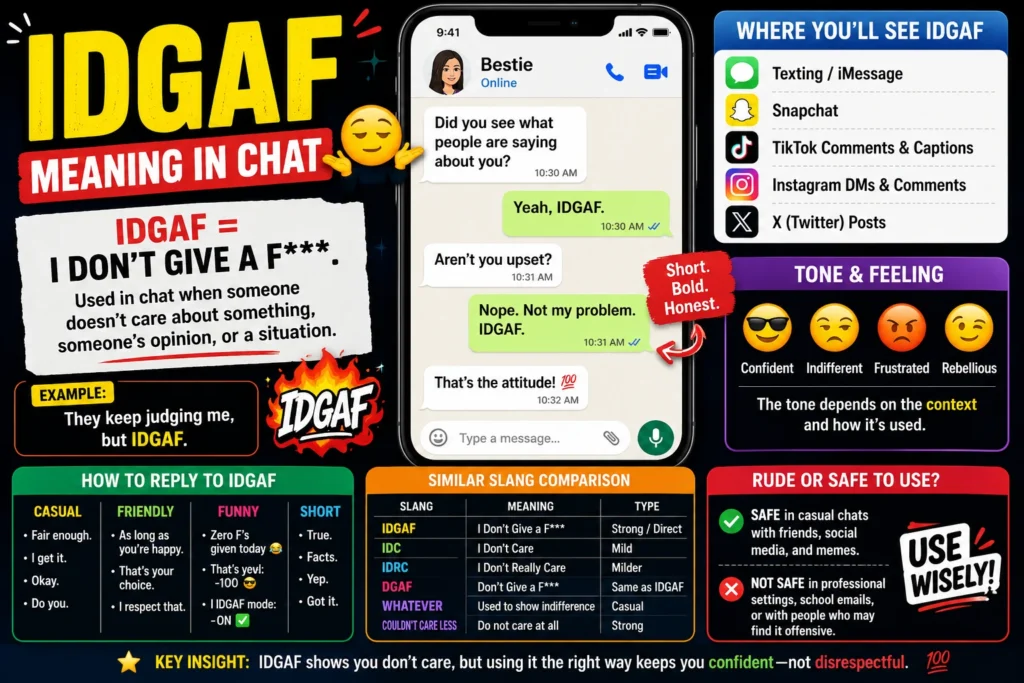
IDGAF stands for “I Don’t Give a F*.”** In chat, texting, and social media, it’s used to show that someone doesn’t care about a situation, opinion, criticism, or outcome.
Depending on the context, IDGAF can sound confident, rebellious, dismissive, frustrated, or even rude.
Example:
“People keep judging my outfit, but IDGAF.”
IDGAF Meaning in Text
If you’ve seen IDGAF in a text message, Snapchat conversation, TikTok comment, or Instagram caption, the sender is usually saying they don’t care about something or don’t want to let it affect them.
The phrase is intentionally strong because it includes profanity. That’s why it often carries more emotion than simply saying, “I don’t care.”
People use IDGAF when:
- Ignoring criticism
- Showing confidence
- Expressing frustration
- Rejecting someone else’s opinion
- Acting carefree
Examples
- “They said I couldn’t do it. IDGAF.”
- “I’m posting the photo anyway. IDGAF what people think.”
- “Everyone’s arguing in the group chat and IDGAF anymore.”
In most cases, the slang emphasizes emotional detachment or defiance.
Real Chat Examples
Friend: Everyone keeps talking about your new haircut.
You: Honestly, IDGAF. I like it.
Snapchat
Friend: Aren’t you worried people will judge you?
You: Nope. IDGAF.
Instagram DM
Friend: Someone left a negative comment.
You: IDGAF. They don’t know me.
Group Chat
Friend: You’re missing the party?
You: Yeah, IDGAF about parties lately. Need some rest.
Emotional Meaning & Tone
The emotional tone behind IDGAF depends heavily on context.
Confident
Someone may use it to show self-confidence and independence.
“IDGAF what anyone thinks about my goals.”
Frustrated
It can express exhaustion after dealing with a problem.
“I’ve explained it five times. IDGAF anymore.”
Rebellious
Many people use it when pushing back against criticism.
“They said I couldn’t wear that. IDGAF.”
Rude
When directed at another person, it can sound harsh.
“IDGAF what you think.”
That’s why tone matters. The same abbreviation can sound empowering or disrespectful depending on who receives it.
IDGAF Meaning From a Girl
When a girl says IDGAF, she’s usually expressing confidence, independence, frustration, or emotional detachment.
Examples:
- “IDGAF what my ex says.”
- “I’m wearing it anyway. IDGAF.”
In many situations, it reflects self-assurance rather than aggression.
IDGAF Meaning From a Guy
When a guy uses IDGAF, it often communicates confidence, toughness, frustration, or a carefree attitude.
Examples:
- “IDGAF about the drama.”
- “People can talk. IDGAF.”
The meaning is generally the same, although some guys use it more casually in conversations with friends.
How to Reply to IDGAF
Your response depends on the tone of the conversation.
Casual Replies
- “Fair enough.”
- “Do what makes you happy.”
- “That’s your choice.”
Friendly Replies
- “As long as you’re happy.”
- “Good for you.”
- “I respect that.”
Funny Replies
- “Your level of caring is officially zero.”
- “That’s some elite confidence.”
- “Noted. The care meter is empty.”
Short Responses
- “True.”
- “Fair.”
- “Got it.”
- “Okay.”
Is IDGAF Rude or Safe to Use?
IDGAF is not always rude, but it is considered strong language.
It contains profanity, so it isn’t appropriate in professional settings, formal conversations, workplace chats, or communication with people who may find it offensive.
Usually Safe
- Close friends
- Casual texting
- Social media captions
- Group chats
Usually Not Safe
- Work messages
- Professional emails
- School assignments
- Conversations with authority figures
Always consider your audience before using it.
Where You’ll See IDGAF
Texting
Used to express confidence or indifference.
Snapchat
Often appears in private chats, stories, or captions.
TikTok
Common in videos about confidence, self-love, and ignoring criticism.
Frequently used in captions, comments, and reels.
Similar Slang Comparison
| Slang | Meaning | Similarity |
|---|---|---|
| IDC | I Don’t Care | Softer version of IDGAF |
| IDRC | I Don’t Really Care | Less intense |
| YOLO | You Only Live Once | Similar carefree attitude |
| DGAF | Don’t Give A F*** | Nearly identical |
| Whatever | Indifference | Milder expression |
| NVM | Never Mind | Different but dismissive |
| Care Too Much | Opposite Meaning | Opposite attitude |
| Unbothered | Not affected | Similar emotional vibe |
👉 Key Insight: IDGAF is stronger than IDC and is usually chosen when someone wants to emphasize that they truly don’t care or refuse to be affected by criticism or negativity.
Variations and Related Expressions
DGAF
Shortened version of IDGAF.
IDC
“I Don’t Care.”
IDRC
“I Don’t Really Care.”
Unbothered
Not emotionally affected.
Whatever
Shows mild indifference.
Couldn’t Care Less
Classic phrase expressing no concern.
Zero F’s Given
Humorous way of saying IDGAF.
No Worries
More polite and relaxed.
Not My Problem
Distances yourself from an issue.
Move On
Suggests letting something go.
Common Mistakes & Misunderstandings
Assuming It’s Always Rude
Many people use IDGAF jokingly or playfully with friends.
Using It Professionally
Avoid it in workplace conversations because of the profanity.
Confusing Confidence With Disrespect
Sometimes it’s self-confidence, not an attack on someone else.
Overusing It
Repeatedly saying IDGAF can make someone seem dismissive or immature.
Other Meanings of IDGAF
In modern internet slang, “I Don’t Give a F*”** is by far the most common meaning.
Occasionally, people may use it humorously or creatively in memes, but almost every social media, texting, and chat context points to the same definition.
FAQ
What does IDGAF mean in Snapchat?
On Snapchat, IDGAF means “I Don’t Give a F*”** and usually expresses confidence, indifference, or frustration.
What does IDGAF mean from a girl?
It typically means she doesn’t care about a situation, opinion, or criticism and wants to emphasize that feeling.
Is IDGAF rude?
It can be. Because it contains profanity, it may sound rude depending on the audience and context.
Is IDGAF stronger than IDC?
Yes. IDGAF is much stronger and more emotional than simply saying IDC (I Don’t Care).
What does IDGAF mean on TikTok?
On TikTok, it’s commonly used to express confidence, self-love, independence, or ignoring negativity.
Can IDGAF be positive?
Yes. Many people use it positively to show self-confidence and stop worrying about others’ opinions.
What’s the difference between DGAF and IDGAF?
Both mean the same thing. DGAF is simply a shorter version.
Why do people say IDGAF?
People use it to show they don’t care about criticism, drama, opinions, or outcomes.
Is IDGAF a bad word?
The abbreviation contains profanity, so some people may consider it offensive.
Can I use IDGAF in a professional setting?
No. It’s best reserved for casual conversations and social media.
Does IDGAF mean confidence?
Sometimes. Many people use it to show confidence and independence.
Is IDGAF popular on social media?
Yes. It’s widely used across TikTok, Instagram, Snapchat, X, and texting apps.
Conclusion
If you’re wondering about IDGAF meaning in chat, it simply stands for “I Don’t Give a F*.”** It’s a popular slang expression used to show indifference, confidence, frustration, or a refusal to care about criticism.
Just remember that while it’s common in texting and social media, the strong language makes it unsuitable for professional or formal situations. Used in the right context, though, it’s one of the internet’s most recognizable ways to say, “I’m not bothered.”